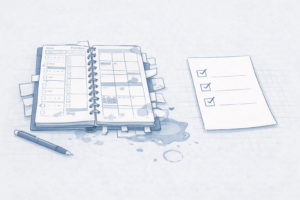
You know exactly what you need to do. The task is clear, the deadline is real, and you’re not even particularly tired. You sit down, open your laptop, and… nothing.
Not the productive kind of nothing where you’re deep in thought. Not the distracted kind where you fall into a social media rabbit hole. Just a strange, paralyzing blankness where your brain refuses to engage. You might rearrange items on your desk. Check your email for the third time in ten minutes. Suddenly remember you need to organize your downloads folder.
This isn’t procrastination in the classic sense—you’re not avoiding the work by doing something more enjoyable. You’re stuck at the threshold, unable to cross from intention into action. And the longer you sit there, the worse it feels.
The Activation Energy Problem
Starting a task requires what behavioral scientists call “activation energy”—the initial psychological effort needed to transition from stillness to action. Your brain operates on an efficiency principle: it resists expending energy unless the payoff is immediate and certain. Beginning a task demands executive function, working memory engagement, and decision-making resources all at once. That’s expensive, neurologically speaking.
Daniel Kahneman’s research on System 1 and System 2 thinking helps explain why. Your default state is System 1—fast, automatic, low-effort processing. Starting a meaningful task requires System 2—slow, deliberate, energy-intensive thinking. The gap between these two states isn’t just uncomfortable; your brain actively resists making the jump.
Think of it like pushing a stalled car. The hardest part isn’t maintaining momentum—it’s that first push to overcome inertia. Except unlike a car, you can’t see the mechanism. You just feel the resistance and assume something is wrong with you.
It’s not. This is how cognitive systems work. The question isn’t why starting is hard; it’s why we expect it to be easy.
Ambiguity Triggers a Threat Response
Here’s what makes starting even harder: most tasks don’t have a clear first step. “Write the report” isn’t an action—it’s an outcome. Your brain needs to answer a series of questions before you can begin: Where do I start? What’s the structure? What information do I need? How should this be organized?
In the absence of clear answers, your brain interprets ambiguity as potential threat. Neuroscientist Beau Lotto’s research shows that uncertainty activates the same neural pathways as physical danger. When you don’t know exactly what to do first, your anterior cingulate cortex—the part that detects errors and conflicts—lights up. You’re not being lazy. Your threat detection system is saying: “We don’t have enough information to proceed safely.”
This is why you can easily start familiar tasks (making coffee, checking email, scrolling your favorite websites) but freeze at novel or complex ones. Familiar tasks have a known sequence. Your brain isn’t solving problems; it’s running a program. Novel tasks require you to write the program while running it.
The Cognitive Load of Choosing How to Start
Even when you know what the task is, you face a hidden decision tax: determining the approach. Should you outline first or dive into writing? Start with research or with what you already know? Work chronologically or tackle the hardest part first?
These aren’t trivial questions. Each represents a branch point where you could potentially waste time or choose poorly. And because you’re choosing before you’ve built any momentum, every option feels equally valid and equally risky. This is what psychologist Barry Schwartz called “the paradox of choice”—more options don’t create freedom; they create paralysis.
The irony? Once you start—with any method—your brain usually figures out a better approach within minutes. But it can’t do that analysis in the abstract. It needs data from actually doing the work. You’re stuck trying to make the perfect choice at the moment when you have the least information.
As Søren Kierkegaard observed in The Concept of Anxiety, “Anxiety is the dizziness of freedom.” When all possibilities are open, action becomes difficult. Structure, even arbitrary structure, dissolves that anxiety.
What Actually Works
These strategies aren’t about finding motivation or building discipline. They’re about reducing the cognitive cost of starting by addressing the specific mechanisms that create resistance.
1. Externalize the exact first action the night before
Don’t write “work on proposal.” Write: “Open proposal template and type three bullet points under ‘Background’ section.” Behavioral scientist BJ Fogg’s research shows that specificity dramatically increases follow-through because it eliminates decision-making at the moment of action. Your evening brain, when stress is lower and executive function is stronger, makes the micro-decisions that your morning brain finds overwhelming. You’re not relying on future-you to be smarter or more motivated—you’re removing the questions that create paralysis.
2. Build a startup ritual that requires zero decisions
Create a sequence you follow every time, regardless of the task: open specific software, fill your water glass, play particular music, put phone in drawer. James Clear writes in Atomic Habits that behaviors become easier when they’re attached to consistent triggers. But the deeper mechanism is cognitive: rituals are pre-made decision chains. You’re not deciding whether to start—you’re just following the sequence. By the time you’ve completed the ritual, you’re often already working without noticing the transition.
3. Give yourself permission to start in the middle
If the introduction feels impossible, write the methodology section. If the project plan overwhelms you, just create the deliverables list. Ernest Hemingway famously wrote: “All you have to do is write one true sentence. Write the truest sentence that you know.” Starting with the easiest or most interesting part builds momentum and generates information. Once you have something—anything—on the page, your brain shifts from construction mode to editing mode. Editing is psychologically easier because it works with existing material rather than generating from nothing. You’re using the cognitive equivalent of inertia.
4. Set a stupidly small timer commitment
Tell yourself you’ll work for exactly two minutes. Economist Richard Thaler’s research on commitment devices shows that we’re more likely to start when the commitment feels trivial. But here’s what happens physiologically: once you begin, your brain releases dopamine in anticipation of completion. The two minutes usually turn into twenty, not through willpower but because you’ve tricked your reward system into engagement. If you truly stop at two minutes, that’s fine too—you’ve moved the threshold and lowered tomorrow’s activation energy.
5. Start with a deliberately terrible version
Tell yourself explicitly: “This draft will be bad.” Perfectionism increases activation energy because the gap between your current state (nothing) and your standard (excellent) feels insurmountable. Anne Lamott’s concept of “shitty first drafts” isn’t motivational—it’s mechanical. By lowering the standard, you reduce the threat signal. Your brain stops treating the task as high-stakes performance and starts treating it as low-stakes experimentation. The quality improvements come later, once you’ve generated raw material.
The Reframe That Changes Everything
You’ve probably noticed that starting gets easier once you’ve built momentum on a project. You sit down and just… continue. No resistance, no paralysis. Why?
Because continuing doesn’t require choosing how to start. You’re not constructing the roadmap while walking it—you’re following yesterday’s route. The cognitive load drops dramatically. Your brain already knows what “work on this” means in concrete terms.
This reveals something crucial: the problem isn’t that you’re undisciplined. The problem is that every day, you’re asking your brain to solve the highest-cost cognitive problem (how to begin an ambiguous task) at the moment when your executive function is least warmed up. That would be hard for anyone.
The solution isn’t forcing yourself across the threshold through sheer will. It’s building systems that lower the threshold itself. Make the first step trivial, specific, and pre-decided. Remove the ambiguity before you need the energy.
Start Here
Tomorrow morning, before you do anything else, write one sentence: the first physical action of your hardest task. Not “start the project.” Not “make progress.” Something like: “Open Figma and create a blank artboard” or “Type the meeting date at the top of my notes document.”
Put that sentence on a sticky note. Tomorrow, when you sit down, your only job is following that instruction. That’s it.
You’re not testing your motivation. You’re testing whether reducing ambiguity changes the experience of starting. One data point is all you need this week.