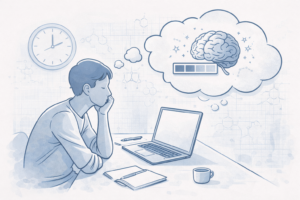
You’re not scrolling Instagram. Your phone is in another room. There are no notifications, no open tabs pulling your attention. You’re sitting in front of the actual task—the report, the email, the project—and your brain is treating it with the same emotional weight as choosing between two identical brands of paper towels.
The conventional focus advice doesn’t land here because it assumes you’re being hijacked by something more interesting. But you’re not. Nothing is interesting. The problem isn’t that TikTok feels more important than your quarterly review. It’s that your quarterly review feels exactly as important as staring at the wall. When people say “I can’t focus,” they usually mean “I keep getting distracted.” What you mean is “I can’t generate the feeling that this matters.”
That’s a different problem entirely. And it requires understanding something most productivity advice ignores: importance is not a feature of tasks. It’s a prediction your brain makes.
The Reward Prediction Shutdown
Neuroscientist Wolfram Schultz won a Nobel Prize for discovering that dopamine neurons don’t fire when you get a reward—they fire when you predict you’ll get a reward. Your brain is constantly running forecasts: if I do this, something good/bad will happen. That prediction generates the feeling of importance. Finish the presentation, impress the client. Send the email, clear the mental clutter. The feeling that it matters isn’t about the task itself—it’s about your brain’s confidence that doing it will change something.
When nothing feels important, your prediction system has flatlined. Not because you’re depressed or burned out (though those can cause it), but because you’ve given your brain too much contradictory data. You’ve completed “important” things that didn’t matter. You’ve skipped “crucial” tasks with no consequences. You’ve reorganized your to-do list forty-seven times while the actual work sits untouched. Your brain has learned that its predictions are unreliable, so it’s stopped making them. The technical term is learned irrelevance. The felt experience is staring at your screen while your coffee goes cold.
Psychologist Kent Berridge calls this the collapse of “wanting.” You might still intellectually know the task needs doing. You might even enjoy it once you start (that’s “liking”). But the motivational pull—the wanting—is absent. And you can’t think your way into wanting. You have to manufacture it.
The Importance Manufacture Framework
Here’s the reframe: you’re not trying to find motivation or rediscover why tasks matter. You’re trying to restart your brain’s prediction engine. That requires one of three things: surprise, specificity, or stakes.
Surprise means doing something different enough that your brain has to recalibrate its predictions. This is why changing locations sometimes works—not because a coffee shop is inspiring, but because novel contexts force your neural prediction circuits back online. Your brain can’t cruise on autopilot when the inputs change.
Sarah, a strategist I know, couldn’t write a single sentence of a client proposal she’d been staring at for three days. Not because she didn’t know what to write—she’d done this exact type of proposal forty times. That was the problem. Her brain had no prediction error to work with. She’d seen this movie. So she did something deliberately awkward: she opened a voice memo app and started describing the proposal out loud as if explaining it to her confused neighbor. Two minutes in, she had a hook she’d never considered. The constraint wasn’t artificial difficulty—it was forcing a format her brain hadn’t predicted. Suddenly there was something to want: finding out if this weird approach would work. The prediction engine hummed back to life. She finished the draft that afternoon, not by finding motivation but by making her brain curious.
The mechanism: prediction error is inherently engaging. When your brain’s forecast is wrong, dopamine fires to encode the surprise. That’s your opening. You’re not looking for tasks that feel important—you’re creating conditions where your brain has to form new predictions.
Specificity means reducing the grain of the decision so small that your brain can actually predict the outcome. “Work on the budget” is too big. Your neural prediction system can’t model that. It’s like asking someone to predict the weather for “sometime this year.” But “open the spreadsheet and update the Q3 actual column” is modelable. Your brain can forecast: I’ll click this file, I’ll see numbers, I’ll type new numbers. Small prediction, small completion, small hit of “I was right about what would happen.”
This is why behavioral activation therapy for depression focuses on micro-actions. Not “be more social” but “text one person.” Not “exercise more” but “put on workout clothes.” The research shows that action generates motivation more reliably than motivation generates action. But it only works if the action is specific enough that your brain can run the forecast.
Marcus, an engineer, spent two weeks avoiding a refactoring project that “should take a day.” Every morning he opened the file, felt nothing, and switched to email. The problem wasn’t complexity—he knew exactly what needed to change. The problem was that “refactor the authentication module” was a fog. His brain couldn’t predict what the next fifteen minutes would actually look like. So he changed the question from “should I start this?” to “what is literally the first function I’d rename?” He wrote it down: userAuth becomes authenticateUser. Then: “I will spend seven minutes renaming this function and seeing what breaks.” Suddenly his prediction system had traction. Seven minutes isn’t enough time to fail catastrophically. The forecast: mild tedium, probably one compiler error. That was enough. The refactor took six hours, but he did it in a single session because each micro-prediction led to the next.
Stakes means borrowing importance from external systems when your internal system is offline. This isn’t about accountability buddies or public declarations—those are motivational theater. Real stakes are structural. You make the prediction “if I don’t do this, something I care about will happen” and then you actually arrange for that thing to happen.
Implementation intentions research by Peter Gollwitzer shows that “if-then” plans dramatically increase follow-through, but only when the “then” is specific and the “if” is externalized. Not “if I feel motivated, then I’ll work on the proposal” but “if it’s 2pm Tuesday, then I’ll draft the intro paragraph, and if I don’t, I’ll cancel Friday’s plans.” The second one works because it removes your prediction system from the loop. The importance isn’t coming from your feelings about the task—it’s coming from your feelings about the consequence.
This only works if you actually enforce it. The borrowed stake has to be real. Tell someone the specific thing you’ll deliver and when, in enough detail that missing it would be concretely embarrassing. Not “I’m working on a project” but “I’ll send you the draft budget by Thursday at noon.” Better: attach a minor punishment you’ll actually feel. “If I don’t finish this by 6pm, I’ll donate $50 to a political campaign I hate.” Your brain might not be able to predict why the budget matters, but it can predict that losing money to a cause you despise will feel bad. That’s a prediction it can work with.
What This Actually Means
The standard productivity narrative says tasks have inherent importance and you need discipline to recognize it. That’s backward. Your brain assigns importance based on whether it can predict that doing the thing will change something. When those predictions break down—because you’ve seen too many “important” tasks not matter or you’ve gotten away with skipping too many “crucial” deadlines—you don’t need better focus techniques. You need to rebuild your prediction system from scratch.
This week, pick one thing that feels like it should matter but doesn’t. Don’t try to convince yourself it’s important. Instead: change the format enough to create surprise, reduce the scope enough to make prediction possible, or attach a stake real enough to generate consequence. You’re not looking for motivation. You’re teaching your brain that its forecasts can be trusted again.
Importance isn’t something you find in a task. It’s something your brain builds from reliable predictions about what happens next.