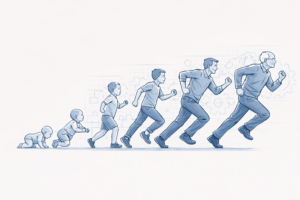
You start strong. The first week, you show up. You log the workouts, write the pages, track the food. Then somewhere around day ten — not dramatically, not with a conscious decision — you just stop. No crisis. No failure. Just a quiet return to exactly who you were before.
The conventional diagnosis is willpower. You didn’t want it enough. You need better habits, more accountability, a vision board. That diagnosis is wrong, and it’s the reason you keep ending up in the same place.
The Real Reason You Quit
Willpower research has been in quiet freefall since Roy Baumeister’s famous “ego depletion” experiments failed replication in 2016. But the deeper problem isn’t that willpower is limited — it’s that willpower is the wrong lever entirely. You’re not quitting because you ran out of fuel. You’re quitting because the behavior you’re trying to sustain doesn’t match who your brain currently believes you are.
Psychologists call this self-concept maintenance. Your brain isn’t just solving problems — it’s constantly writing and protecting a coherent narrative about who you are. When new behaviors contradict that narrative, your brain doesn’t cheer for the change. It edits it out.
This is why you can want something genuinely, commit to it seriously, and still find yourself back at zero two weeks later. The problem isn’t desire. It’s that you’re asking a character in one story to perform scenes from a completely different one.
The Identity Lag
Your behavior is always about twelve months behind your intentions. Not because you’re lazy — because identity updates slowly, and behavior follows identity, not the other way around.
Call this the Identity Lag: the gap between who you’re trying to become and who your brain still thinks you are. Every day you show up, you deposit evidence toward a new self-concept. Every day you skip, you confirm the old one. The gap between your intentions and your behavior isn’t motivational. It’s narrative.
James Clear argued that “every action you take is a vote for the type of person you wish to become” — but he undersells the resistance. It’s not just that votes accumulate slowly. It’s that your brain is an incumbent protecting its seat. New behaviors don’t just need to win; they need to defeat a story with years of supporting evidence behind it.
What This Looks Like in Practice
You decide to start running. Day one is fine — there’s energy in beginning. By day eight, you wake up tired and it’s raining, and the thought that surfaces isn’t I don’t feel like it. It’s something quieter and more corrosive: this isn’t really me.
That thought is your self-concept doing its job. It’s not sabotage — it’s protection. Your brain has substantial evidence that you are someone who doesn’t run, and eight days of counter-evidence haven’t shifted the narrative yet. So when conditions get hard, the old story wins by default.
The mistake most people make here is responding with more motivation — replaying their why, recommitting loudly, watching a documentary about ultramarathons. This doesn’t work because it’s still treating the problem as motivational. You don’t need to want it more. You need to accumulate enough evidence to make the new identity feel true.
Close the Gap Faster
The most effective thing you can do is shrink the behavior until it can’t be failed — then do it anyway when you don’t want to.
Not three miles. Run to the end of your street. Not 1,000 words. Write one sentence. Not twenty minutes of meditation. Sit down and close your eyes for sixty seconds.
This isn’t about building habits through small steps. It’s about depositing identity evidence even when the conditions are wrong. The run to the end of the street in the rain does more identity work than the perfect three-mile run on a good day — because it proves something harder: that you show up when it doesn’t feel worth it.
A novelist who’d quit three separate attempts at a daily writing practice tried this. She stopped tracking word counts entirely and started tracking one variable: did she open the document today? Some days she wrote 800 words. Some days she stared at it for four minutes and closed it. After six weeks, something shifted — not her output, but her answer to are you a writer? She’d stopped hedging. The evidence had accumulated past the tipping point.
The tradeoff she didn’t expect: smaller commitments meant slower visible progress. She didn’t finish faster. But she stopped quitting — which meant she finished at all.
Audit Your Quitting, Not Your Starting
Most people treat quitting as a moment of failure. It isn’t. Quitting is a pattern, and patterns have structure.
Spend one week noticing when you quit, not that you quit. At what hour? After which events? On which days? You’ll almost certainly find that your quitting has a signature — a specific set of conditions that reliably precede the abandonment.
For most people, it’s not weakness in general. It’s a particular trigger: a bad night’s sleep, a stressful afternoon, the specific moment when early novelty has worn off but the new identity hasn’t solidified yet. Behavioral economists call this the valley of despair — the trough between initial enthusiasm and genuine competence where quit rates peak. It’s predictable. Which means it’s manageable.
If you know your signature, you can interrupt it — not with motivation, but with a pre-committed rule. If it’s after a hard day, the bar drops to the minimum viable version. Not optional. Not negotiated in the moment. Pre-decided. The minimum version still deposits the evidence that counts.
The Reframe That Actually Moves Things
Stop thinking of quitting as a character flaw and start thinking of it as a timing problem. You’re not someone who can’t follow through. You’re someone whose identity hasn’t caught up to their intentions yet.
That distinction changes everything you do next. A character flaw calls for judgment, willpower, possibly shame. A timing problem calls for a specific kind of patience — not passive waiting, but active evidence-collection. Every small showing-up closes the gap a fraction.
You won’t close it with one dramatic recommitment. You’ll close it the way the lag opened: gradually, almost invisibly, until one day the voice that says this isn’t really me gets quieter, then confused, then silent.
This week: pick the one thing you’ve quit on most recently, reduce the minimum viable version to something almost embarrassingly small, and do it on the days it doesn’t feel worth it. Especially those days.
The goal isn’t to become someone who never quits. It’s to become someone who keeps showing up long enough for the new version of you to start feeling like the real one — because you have to act like that person before you believe it.