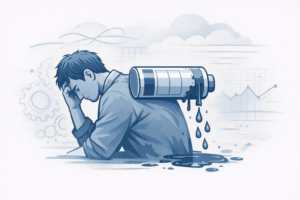
You’ve read the articles. You’ve set the alarm for 5:30 AM to meditate. You’ve bought the running shoes. You’ve downloaded the habit tracker. And for three days, maybe even three weeks, you do it. Then you don’t. And the standard explanations roll in: you lack discipline, you didn’t make it easy enough, you need better accountability. But here’s what actually happened: you tried to add a new habit to a day that was already running at capacity. The meditation failed not because you’re undisciplined, but because you never decided what you’d stop doing to make room for it.
We treat habit formation like construction on empty land. But your day isn’t empty land. It’s Manhattan.
Every hour is already claimed by existing habits—most of which you don’t even recognize as habits because they’ve become invisible. The problem isn’t building new habits. It’s that you’re trying to build them without evicting the ones already there. You don’t have a discipline problem. You have a real estate problem.
The Collision You Don’t See
When Stanford behavior scientist BJ Fogg studied habit failure, he found something unexpected: the habits that stick aren’t the ones people are most motivated to do. They’re the ones that successfully compete for space against existing routines. You already have a 6 AM habit—it’s called hitting snooze, scrolling your phone in bed, and starting your day in reactive mode. That habit owns that time slot. Your meditation aspiration is trying to claim occupied territory.
The brain has limited capacity for conscious decision-making. Roy Baumeister’s research on ego depletion showed we make roughly 35,000 decisions a day, and each one drains the same finite resource. By 10 AM you’ve already decided whether to shower before or after coffee, which shirt to wear, which route to take to work, whether to check email or Slack first, and which of the 47 tasks on your list deserves attention. You’re exhausted before you’ve started anything meaningful.
Here’s the mechanism everyone misses: habits exist to solve this problem. They’re the brain’s efficiency protocol, outsourcing decisions to automatic subroutines. The reason you can’t “just add” a morning meditation is the same reason you can’t just add another app to a phone with full storage. Something has to go. The question isn’t whether you can build the new habit. It’s what habit you’re displacing.
Habit Real Estate: The Framework You Need
Think of your day as having exactly 100 units of habit space. Right now, all 100 are occupied. Morning coffee while checking email: 5 units. Evening Netflix spiral: 15 units. Stress-scrolling between tasks: 8 units. Most aren’t consciously chosen—they’re squatters that moved in and never left.
When you try to add a new habit without freeing up space, you’re attempting to cram 105 units into a 100-unit system. The new habit isn’t just competing with empty time. It’s competing with entrenched routines that have claim to specific triggers, rewards, and neural pathways. This is why “just do it for 30 days” fails. The old habit doesn’t disappear because you’re temporarily ignoring it. It waits. And the moment you relax your vigilance, it reclaims its territory.
The solution: stop thinking about building habits. Start thinking about trading them.
The Replacement Audit
Sarah, a product manager, wanted to read more. She tried waking up earlier, failed. Tried reading before bed, lasted four days before exhaustion won. The breakthrough came when she tracked what she actually did between 8-9 PM for a week. The answer: scrolled Twitter, ostensibly to “decompress,” actually to avoid the anxiety of an empty evening. Reading wasn’t failing because she lacked time. It was failing because Twitter already owned that slot, and its reward system (infinite novelty, zero commitment) was stronger than reading’s (delayed gratification, cognitive effort).
Her solution wasn’t to fight Twitter with discipline. It was to design the displacement. She deleted Twitter from her phone but installed it on her laptop, which lived in her office. The habit’s trigger (sitting on couch, feeling Done with Day) remained. But the behavior it triggered changed: without phone-Twitter available, her hand reached for the book on the coffee table instead. Not because she became more disciplined. Because she evicted the squatter and moved in a better tenant.
This is the first strategy: identify your actual habits, not your aspirational ones. For one week, track what you do during the time you want to claim for your new habit. Not what you think you do—what you actually do. You’ll find you’re not choosing between “new habit” and “nothing.” You’re choosing between “new habit” and “existing habit you didn’t realize was a habit.” Name it. Then design its replacement, not its removal.
The key insight from Wendy Wood’s habit research: context is stronger than motivation. Don’t create blank space and trust yourself to fill it correctly. Create replacement behavior triggered by the same context. Same couch, different book. Same morning alarm, different first action. The trigger stays; the behavior changes.
Habit Displacement: The Strategy That Actually Works
James wanted to stop checking work email before bed. He tried rules (“no phone after 9 PM”), failed. Tried willpower, failed. What worked: he started reading physical newspapers in the exact spot where he used to doomscroll email—his bed, under the reading light, at 9 PM. The habit’s architecture remained identical: same time, same place, same “winding down” frame. Only the behavior changed.
This reveals the counterintuitive mechanism: successful habit change often requires keeping more elements the same than you’d expect. The work-email habit owned the trigger (in bed, evening, restless), the location (under reading light), and the reward function (something to process before sleep). James’s newspaper reading kept the trigger, location, and even the reward (processing text) while changing only the content.
Critically, he didn’t stop the email habit through removal. He evicted it through displacement. The newspaper filled the space so completely that email couldn’t reclaim it. When he occasionally reached for his phone out of muscle memory, the newspaper was already in his hands. The real estate was occupied.
The mistake most people make: they try to delete habits, leaving vacant space. But the brain abhors a vacuum. The old habit will rush back in unless something else holds the territory. This is why “just stop” doesn’t work but “do this instead” often does. You’re not fighting the old habit’s momentum. You’re redirecting its energy into new infrastructure.
What You’re Actually Building
You’re not building discipline or willpower. You’re renovating your day. Every new habit requires demolition and reconstruction. The reading habit can’t coexist with the Twitter habit in the same time slot—one has to move. The morning meditation can’t share space with the phone-scrolling routine. They’re competing for the same neural real estate, and only one can hold the deed.
This reframe changes everything. Instead of asking “How do I build this habit?”, ask “What habit currently owns this space, and how do I transfer the lease?” The failure point isn’t your first week doing the new thing. It’s month two, when you get sick or busy, and the old habit sees an opening to reclaim its territory. Sustainable change isn’t about addition. It’s about permanent displacement.
This Monday, don’t add a new habit. Trade one. Pick the new behavior you want. Identify the existing behavior that owns that time, space, or trigger. Design the replacement—not the removal—with surgical precision. Then watch what happens when you stop trying to do more and start being strategic about what you’re actually doing.
You’ve never had a discipline problem. You’ve had an real estate problem. And the good news about real estate: once you understand it, you don’t need more willpower. You just need better zoning laws.