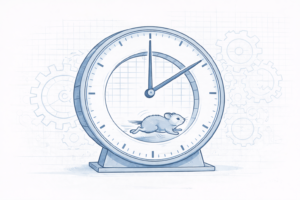
You’ve tried the Pomodoro technique, time-blocking, the two-minute rule, Getting Things Done, eating the frog, and that app everyone swears by. You’ve set boundaries. You’ve batch-processed your email. You’re more organized than you’ve ever been.
And you’re more exhausted than you’ve ever been.
Here’s what no one tells you: burnout isn’t caused by working too hard. It’s caused by the accumulated cost of preventing yourself from working in ways that feel natural to you. Every productivity system you adopt, every optimization you implement, every “best practice” you force yourself to follow creates what I call the Translation Tax—the cognitive cost of constantly converting your actual work into someone else’s framework for how work should be done.
The Exhaustion Hiding in Plain Sight
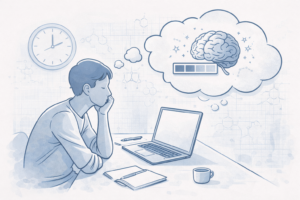
You know the feeling. It’s 10 AM and you haven’t started your “real work” yet because you’ve been: migrating tasks between your project management tool and your daily planner, deciding whether this counts as Deep Work or should be batched with similar tasks, checking if you’re in your peak productivity window according to that article you read, and color-coding your calendar to ensure proper work-life balance.
You’re not procrastinating. You’re performing productivity.
Psychologist Roy Baumeister’s research on ego depletion revealed that self-control is a finite resource—each decision, each act of willpower, each moment of forcing yourself to work against your grain depletes the same tank. But here’s what gets missed: the depletion isn’t coming from your actual work. It’s coming from the constant micromanagement of how you approach that work. You’re not just writing the report; you’re also deciding which productivity technique to apply while writing it, monitoring whether you’re following that technique correctly, and judging yourself for the seventeen times you’ve already deviated from it today.
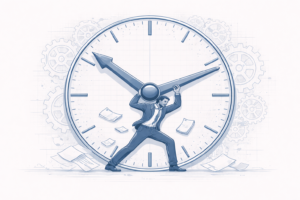
The productivity industrial complex has convinced you that the solution to feeling overwhelmed is more structure, more systems, more optimization. But structure requires maintenance. Systems require compliance. Optimization requires monitoring. You’ve built a second job on top of your actual job, and that second job is managing the performance of doing your first job correctly.
What We Mistake for Laziness
When someone tells you they can’t stick to a productivity system, the typical diagnosis is lack of discipline. But consider what professor of organizational behavior Amy Wrzesniewski found in her research on job crafting: people who modify their work to align with their natural strengths and preferences report significantly higher engagement and lower burnout—even when working the same hours under the same conditions as their depleted colleagues.
The insight: what looks like resistance to your productivity system might actually be your brain protecting itself from unnecessary translation costs.
Think about the last time you got absorbed in work without consulting a system. Maybe you ignored your carefully time-blocked calendar and spent three hours solving a problem that “should have” taken forty-five minutes across three separate sessions. Maybe you worked in a chaotic burst instead of the steady, measured pace your app recommended. You probably finished and felt guilty about your approach, even though you produced something excellent.
That guilt is the Translation Tax sending you a bill.
The System Your Brain Already Has
Here’s the framework shift: you don’t need a productivity system. You need to identify and eliminate the places where you’re forcing your work through someone else’s productivity system. Barry Schwartz’s research on the paradox of choice showed that more options decrease satisfaction and increase anxiety. Every productivity system you try to implement is another option to manage, another framework to toggle between, another way to feel like you’re doing it wrong.
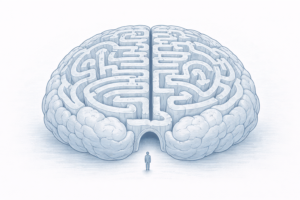
Your brain already has a system. It’s the one that emerges when you’re working on something you care about without external frameworks. Some people think in long, uninterrupted blocks. Others think in scattered bursts across a week, circling the same problem from different angles. Some people need to talk through ideas; others need to write their way to clarity. None of these approaches look like the “optimal” workflow in your productivity app, but all of them work.
The strategy isn’t to find a better system. It’s to document what you actually do when work feels effortless, then design your week to protect those conditions instead of fighting them.
Working in Translation
Sarah, a project manager at a tech company, used Notion, Asana, and Todoist simultaneously—different tools for different contexts, each requiring her to re-enter the same information in different formats. She thought this was optimization. It was actually fragmentation. Her “productivity stack” meant every task lived in three places, which meant every update required three transactions, which meant before she could think about her actual work, she had to think about which system needed which update in which format.
When she finally abandoned two of the three tools (keeping only the one her team used, eliminating her personal optimization layer), something unexpected happened. She didn’t lose track of anything. Instead, she regained the mental bandwidth she’d been spending on system maintenance. The work itself became easier because she stopped paying the Translation Tax three times per task.
The pattern: the moment you stop managing how you’re supposed to be working and just work, the exhaustion lifts. Not because you’re working less—because you’ve eliminated the second job of performance.
Try this: For one week, keep a “Translation Log.” Every time you catch yourself doing meta-work about your work (updating systems, reorganizing tasks, checking if you’re following your method correctly), write down what triggered it. By Friday, you’ll see the pattern—the specific moments where you’re bleeding energy into productivity theater. Those are your elimination targets. Remove one per week until you’re left with only the structures that serve the work rather than the structures that serve the appearance of organization.
The Metric That Misleads
You’re measuring the wrong thing. Hours worked, tasks completed, inbox zero achieved—these metrics all measure compliance with a system, not the actual value you created. Annie Dillard wrote, “How we spend our days is, of course, how we spend our lives.” But we’ve perverted that wisdom into its opposite: we spend our days performing productivity, then wonder why our lives feel performative.
The companies you admire weren’t built by people who had pristine task management systems. They were built by people who got obsessed with a problem and worked on it in whatever chaotic, inefficient, “wrong” way moved them forward. The system came later, after the thing was built, to help other people replicate what was essentially unreplicable: the specific conditions under which that person’s brain did its best work.
Your second strategy: Identify one thing you do regularly that feels inefficient but produces your best work. Maybe it’s thinking while walking instead of at your desk. Maybe it’s working on three projects simultaneously instead of sequentially. Maybe it’s starting your day with email (gasp!) because that’s how your brain warms up. Now protect that “inefficiency” as fiercely as you’d protect a meeting with your CEO. Build your schedule around it instead of trying to fix it.
Mark, a software engineer, realized his best debugging happened between 10 PM and midnight—exactly when every productivity article told him he should be winding down. For months, he fought this, trying to force himself into a 9-5 rhythm with his peak work in the morning. He was miserable and half as effective. When he finally restructured his day to start at 11 AM and work until 7 PM, with his hardest problems saved for his natural peak at night, his output doubled and his Sunday-evening dread disappeared. The system didn’t change him; he changed the system to match how he actually works.
What Burnout Really Is
Burnout researcher Christina Maslach identified three components: exhaustion, cynicism, and inefficacy. Notice what’s missing from that list: overwork. You can work intensely for long periods without burning out if the work feels aligned with how you actually think and operate. You burn out when there’s a constant gap between who you are and who you have to perform being. The Translation Tax is that gap, compounding daily.
The reframe: burnout prevention isn’t about protecting yourself from work. It’s about protecting your work from productivity theater. It’s about giving yourself permission to work in ways that look wrong to everyone who’s trying to sell you a system, but feel right to the person actually doing the work.
Your weekly practice: Every Sunday, ask yourself one question: “What did I do this week that felt like work about work rather than actual work?” Write it down. Don’t judge it, don’t fix it yet—just notice it. After a month, you’ll see your personal Translation Tax pattern. Most people discover they’re spending 15-20 hours per week managing how they work instead of working. That’s not a time management problem. That’s a permission problem.
The Permission You’re Waiting For
You’re waiting for someone to tell you it’s okay to ignore the system that’s supposed to make you better. You’re waiting for permission to work in the messy, non-optimal, untrackable way that actually produces your best thinking. You’re waiting for proof that you’re not just being lazy when you abandon the framework everyone says you should follow.
Here’s your permission: the exhaustion you feel isn’t from doing too much. It’s from doing your work twice—once in the actual world, once in the productivity theater that promises to make you better at it. You don’t need a better system. You need the courage to stop performing productivity and start protecting the conditions under which your work actually happens.
Burnout isn’t the cost of working hard—it’s the cost of working like someone else.