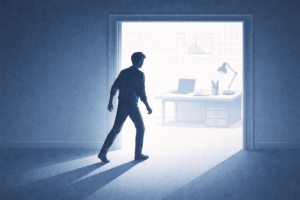
You’ve cleared your calendar. Silenced your phone. Made coffee. Sat down at your desk with clear intention: Today, I’m getting into flow.
Two hours later, you’ve rewritten the same paragraph four times, checked your email twice “just to clear it,” and somehow ended up reading about the migratory patterns of Arctic terns. The harder you tried to concentrate, the more your mind scattered. You know what flow feels like—you’ve experienced those rare afternoons when three hours vanished and you produced your best work. But you can’t seem to manufacture it on demand.
Here’s the uncomfortable truth: you can’t force flow. In fact, trying to force it is precisely what prevents it from happening.
Why Your Brain Resists Direct Commands
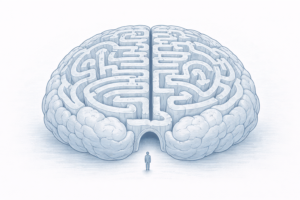
Flow states emerge from a specific neurological configuration. When you’re in flow, research suggests that your prefrontal cortex—the part of your brain responsible for self-monitoring and conscious control—may temporarily reduce certain types of activity. This is why time distorts, why self-consciousness disappears, why the work feels effortless.
But here’s the paradox: the act of trying to enter flow requires the very self-monitoring that flow requires you to shed.
Psychologist Daniel Wegner demonstrated this mechanism in his ironic process theory. When you try NOT to think about something—say, a white bear—your brain splits into two processes. One tries to suppress the thought. The other monitors whether you’re succeeding, which requires repeatedly checking for… the white bear. The monitoring process undermines the suppression.
The same structure applies to flow. When you sit down determined to “get into flow,” you activate your monitoring systems. Part of your brain constantly checks: “Am I focused yet? Is this flow? Why isn’t this working?” Each check pulls you further from the state you’re chasing.
William James explored this phenomenon in his writings on attention, observing that the harder we strain to focus on a given object, the more susceptible we become to distraction. Your effort itself becomes a distraction.
The Attention Trap
Most productivity advice treats attention like a muscle you can flex harder. Just eliminate distractions. Just try harder. Just want it more.
This fundamentally misunderstands how attention works. Attention isn’t a resource you deploy through willpower—it’s an emergent property of the relationship between your cognitive state and your task.
Mihaly Csikszentmihalyi, who coined the term “flow,” identified the key conditions: The challenge must match your skill level, you need clear goals, and you need immediate feedback. Notice what’s absent from this list: determination, willpower, or trying really hard.
In fact, research on peak performance shows that athletes and artists who achieve flow states consistently describe a quality of effortlessness. Violinist Midori described it as “when I stop trying to play perfectly and just play.” The trying is the obstacle.
Here’s what appears to happen neurologically: Flow emerges when your task demands enough attention to occupy your conscious mind without overwhelming it. Some researchers hypothesize this creates what’s called “transient hypofrontality”—a temporary reorganization of prefrontal activity. Your executive functions quiet down or shift their focus. Action and awareness merge.
But conscious effort activates your prefrontal cortex. The monitoring, evaluating, striving—these are executive functions. You’re holding the door closed while trying to walk through it.
The Conditions You Can Control
If you can’t force flow, what can you do? You can’t directly create the state, but you can reliably create conditions where it’s more likely to emerge.
1. Match the challenge to your current capacity (not your aspirational capacity)
Flow exists in a narrow band: tasks slightly above your current skill level. Too easy, and you’re bored. Too hard, and you’re anxious. Both prevent flow.
The problem is, most of us set up challenges based on where we think we should be, not where we actually are. You’ve been away from coding for two weeks, but you dive into the hardest problem first because that’s what a “serious developer” would do. Mismatch.
Instead, spend the first 20-30 minutes on a task you find almost trivially easy in this domain. Let your brain remember what competence feels like. Then gradually increase difficulty. You’re not procrastinating—you’re calibrating.
2. Build approach rituals, not performance demands
Your pre-work routine should cue your brain for the task without creating pressure about the outcome. This is the distinction between “I’m going to write my best work today” (performance demand) and “I’m sitting down with my laptop and opening my manuscript file” (approach ritual).
Research on implementation intentions shows that “when X, then Y” structures work because they create automaticity. Your brain stops deliberating and starts doing. Make coffee, sit in the same chair, open the same application, start with the same small action. Not because it guarantees flow, but because it removes the decision-making that activates executive function.
Professional writers often describe this: they don’t sit down to write a masterpiece. They sit down to fill the page. The performance anxiety dissolves into process.
3. Remove friction from starting, not from the entire task
Conventional wisdom says to eliminate all distractions. But this often backfires. You spend so much energy creating perfect conditions that you’re mentally exhausted before you start. Plus, you’ve now invested heavily in the outcome: “I cleared three hours for this—it HAS to work!”
A more effective approach: make the first two minutes absurdly easy to start. Don’t organize your entire workspace—just open the file. Don’t outline the whole project—just write one sentence about what you’re working on. Don’t achieve inbox zero—just put your phone in another room.
The Zeigarnik effect offers one explanation for why this works: research suggests that starting a task can create cognitive tension around incompletion. Once you’ve written that first sentence, your mind may naturally continue working on the problem. But you have to actually start, not just prepare to start.
4. Time-box the attempt, then release it
Set a specific period—say, 90 minutes—where you’ll work on the task. During that time, you work. When it ends, you stop, regardless of whether flow happened.
This does two things: First, it prevents the creeping anxiety of an undefined work period (“how long will this take?”). Second, it removes the stakes from any individual session. You’re not trying to achieve flow in this session. You’re just completing one work block.
Paradoxically, removing the pressure to achieve flow in this session makes flow more likely. Your monitoring systems quiet down because there’s nothing to monitor except time.
5. Recognize near-flow and work with it
You won’t always achieve the transcendent state where hours vanish. But you’ll often hit something adjacent: sustained attention that requires some effort but feels productive. Most people dismiss this as “not real focus” and break their momentum looking for the deeper state.
This is a mistake. Research on attention shows that even moderately sustained focus produces quality work and creates positive reinforcement that makes deeper focus more accessible in future sessions. Work with what emerges instead of abandoning it in pursuit of the ideal state.
Think of it like sleep: sometimes you fall into deep, restorative sleep immediately. Sometimes you have a lighter sleep that still rests you. Lying awake insisting “I must achieve deep sleep right now” guarantees you’ll achieve neither.
The Reframe: From Achievement to Conditions
The shift required here is profound: stop treating flow as something you achieve and start treating it as something you allow.
This isn’t semantic. Achievement orientation activates exactly the self-monitoring that prevents flow. When you frame it as “creating conditions,” you’re working with your brain’s architecture instead of against it.
Philosopher Martin Heidegger distinguished between “ready-to-hand” and “present-at-hand”—tools you use unconsciously versus tools you examine consciously. A hammer is ready-to-hand when you’re focused on the nail, present-at-hand when you stop to look at the hammer itself. Flow requires your attention to be ready-to-hand, but trying to achieve flow makes it present-at-hand.
The Taoist concept of wu wei captures this: effortless action, not because no effort is involved, but because the effort isn’t self-conscious. You’re chopping wood, not monitoring yourself chopping wood while evaluating whether you’re chopping wood correctly.
The irony is that accepting you can’t force flow often allows it to happen. Not because acceptance is magic, but because it quiets the monitoring systems that were blocking access.
This Week: The Twenty-Minute Start
Don’t try to optimize your entire work process. Don’t clear tomorrow for a flow marathon.
Instead, tomorrow, set a timer for 20 minutes. Choose a task in your domain where you’re genuinely competent—not the hardest thing on your list, but something you know you can do.
Start working. When your mind wanders or the monitoring kicks in (“Is this flow yet?”), notice it and return to the task. You’re not trying to achieve flow. You’re testing whether 20 minutes is enough to get absorbed without the pressure of an undefined time commitment.
That’s it. Not a system. Not a protocol. One data point about what happens when you remove the demand for peak performance.
You might find flow. You might not. But you’ll learn something about the conditions that work for your brain, which is more valuable than another failed attempt to force something that can’t be forced.