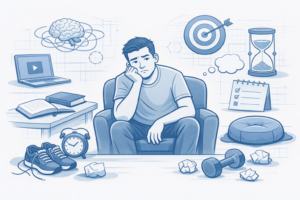
You have a project due in three weeks. You’re not panicking yet—which means you’re not moving yet. So you wait until the deadline is close enough to feel the heat, then you sprint. You deliver. You also feel terrible. And next time, you run the exact same play.
The standard advice is to fix the system: time blocks, accountability partners, artificial deadlines. But all of these share one assumption—that urgency requires pressure. That assumption is wrong, and it’s why most people never find the middle ground between paralysis and panic.
Here’s the distinction that changes everything: urgency is motion. Stress is a physiological state. They travel together constantly, but not because they have to. Because of how we’ve been taught to manufacture one using the other.
What Your Brain Is Actually Doing
Urgency hacks work by making inaction painful in the present tense. You post publicly that you’ll finish the manuscript by June. Now the cost of not finishing is social embarrassment, which your brain registers as a live threat. Cortisol rises. You move.
This works. But it works the same way stress works. You’re not creating urgency—you’re borrowing it from threat.
The underlying mechanism is temporal discounting, a well-documented phenomenon in behavioral economics: your brain systematically undervalues future events. A project due in three weeks feels less real than the email in your inbox right now. Deadlines work by collapsing that distance—making the future feel present through danger. But “present danger” is the definition of stress. Every urgency hack that works this way is just a stress machine with better branding.
The question nobody bothers to ask: can you make the future feel present without threat?
The Ratchet, Not the Spring
A spring creates urgency through stored tension. Compress it enough, and it releases—fast, forceful, and briefly. That’s the deadline model. But you can’t stay compressed. Springs either release or break.
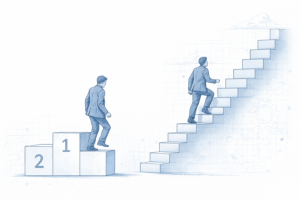
A ratchet works differently. Each click is small, irreversible, and creates the conditions for the next click. There’s no stored tension. There’s accumulated direction. You don’t feel the pressure of a spring; you feel the momentum of a ratchet.
Urgency without stress is ratchet motion. The goal isn’t to build up enough pressure to finally move. It’s to design conditions where each action makes the next one feel obvious.
Making the Future Vivid
Your brain moves toward things it can see and away from things that feel abstract. Most future goals are abstract—they exist somewhere conceptual, disconnected from Tuesday morning. Deadlines work by making the threat concrete. But you can also make the opportunity concrete, and that’s where urgency without stress lives.
Researchers call this episodic future thinking—the deliberate act of mentally simulating a future scenario in sensory detail. When subjects used it before making decisions, their temporal discounting dropped significantly. The future stopped being theoretical. It started pulling them forward.
This isn’t visualization in the motivational-poster sense. It requires precision. Not “things will be better”—but: what’s the first meeting that changes when this is done? What conversation happens? What does it feel like to walk into that room?
The specificity is the mechanism. Vague futures stay abstract. Concrete futures exert gravitational pull.
When Marcus Aurelius wrote in Meditations, “Think of yourself as dead. You have lived your life. Now take what’s left and live it properly”—that’s not morbid philosophy. That’s temporal discounting hacked in the other direction. He’s making the cost of inaction vivid by rendering the future in high resolution.
Name the Cost, Not the Task
Most to-do lists are catalogs of actions. “Send proposal.” “Review financials.” Tasks with no felt weight.
Before you start work, spend 90 seconds naming what doesn’t happen if you don’t do the most important thing today. Not hypothetically. Specifically: “If I don’t finish this proposal today, I send it Friday, which means I revise over the weekend, which means I miss my daughter’s soccer game to fix errors I could have avoided Tuesday morning.”
That’s not guilt. Guilt looks backward at failure. This looks forward at avoidable loss. One contracts you; the other moves you.
What surprises people when they try this is how quickly the urgency appears—not as panic, but as clarity about what to do first. The task doesn’t change. Your relationship to it does. The motion comes from seeing, not from pressure.
Build Visibility Into Progress
The thing that kills momentum isn’t laziness—it’s invisibility. When progress isn’t visible, each day starts from zero emotionally, even if you’ve moved forward. The project feels as far away Tuesday as it did Monday.
Fix: at the end of each workday, write one sentence about what’s now true that wasn’t true yesterday. Not what you did—what changed. “The structure is solid. The opening still needs work.” That’s it.
A writer working on her first book tried this and found something unexpected: the daily sentence made the project feel closer, not further. Not because she was moving faster—but because she could see the distance shrinking. That’s the ratchet clicking. Each piece of visible progress pulls the next one forward. The urgency compounds without the pressure ever building, because motion stops feeling like effort and starts feeling like direction.
The Structural Shift
Most people treat urgency as something that happens to them—a feeling generated by proximity to deadline. So they manipulate the deadline to manipulate the feeling. But urgency is a quality of perception, not time. It’s what happens when your brain decides something is real.
You don’t need more pressure. You need better rendering.
This distinction matters beyond productivity. A life spent moving from deadline to deadline is a life spent borrowing urgency you never own. A life where you’ve learned to make the future feel real—on your own terms, without threat—is a fundamentally different experience of what it means to be busy.
This week: pick one project you’ve been circling. Spend five minutes writing the specific scene six months from now when it’s done—who’s in the room, what’s said, what you feel walking in. Then write the one sentence about what’s now true today that wasn’t true last week.
Not a new system. Not a commitment device.
Urgency was never a time problem. It was always a visibility problem—and the only thing standing between you and it is how clearly you can see what’s actually at stake.