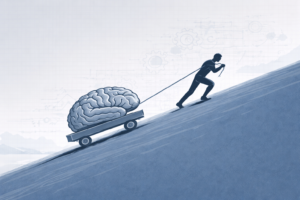
You’ve been trying to force yourself to wake up early for six months. Every night you set the alarm with genuine conviction. Every morning you hit snooze with genuine relief. The gap between who you’re trying to force yourself to be and who you actually are isn’t shrinking—it’s widening. Each failed morning doesn’t just cost you the early start; it confirms a story you’re telling yourself about weakness.
Here’s what nobody tells you: the forcing is the problem.
Every time you successfully drag yourself out of bed through sheer willpower, you’re not building discipline. You’re training your brain that waking early requires force, that it’s inherently unpleasant, that you’re the kind of person who needs to be coerced into doing it. You’re not getting stronger. You’re teaching yourself to resist.
The Forcing Paradox
Psychologist Jack Brehm identified this mechanism in the 1960s when studying what he called psychological reactance. When people feel their freedom is being constrained—even by themselves—they instinctively resist. Tell yourself you must go to the gym, and part of you immediately starts building the case for why you shouldn’t. The force creates the counterforce.
This explains why New Year’s resolutions collapse by February. You’re not weak. You’re experiencing a predictable psychological response to self-coercion.
Self-determination theory, developed by Edward Deci and Richard Ryan over decades of research, demonstrates that human motivation operates on three fundamental needs: autonomy, competence, and relatedness. Notice what’s not on that list: force. When you frame discipline as forcing yourself to do what you don’t want to do, you’re directly attacking your need for autonomy. Your resistance isn’t a character flaw. It’s a defense mechanism.
The writer David Foster Wallace captured this perfectly: “The truth will set you free. But not until it is finished with you.” The truth about discipline is that it’s not about overpowering yourself. It’s about removing the need for power entirely.
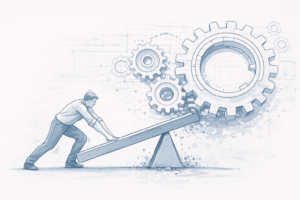
Leverage Points
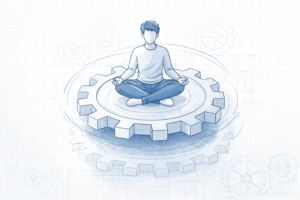
Think of discipline not as force applied to resistance, but as friction removed from a system. You don’t need more willpower. You need to find the single point where a tiny change eliminates the need for willpower altogether.
My friend Elena spent two years trying to force herself to exercise regularly. She’d set alarms, prep workout clothes, schedule gym sessions in her calendar, give herself motivational speeches about health and longevity. Every strategy was about applying more force to overcome her resistance. What finally worked wasn’t more force—it was changing her commute.
She started walking past a climbing gym on her way home from work. The first week, she just walked past. The second week, she went in once to look around, no pressure to climb. By week three, she was stopping in twice a week because she was already there, because she’d seen people at her skill level, because it required zero additional decisions. Within two months, she was climbing four times a week. Not because she’d become more disciplined, but because she’d removed the friction point: the decision to go was already made by her commute.
This is what I call leverage point thinking. The discipline problem isn’t usually the activity itself—it’s the twelve micro-decisions and physical obstacles between you and the activity. Elena’s leverage point wasn’t “be more motivated to exercise.” It was “walk past a gym.” One environmental change, zero force required.
Channel, Don’t Constrain
Real discipline looks nothing like gritting your teeth. It looks like a canal system.
BJ Fogg’s research at Stanford shows that behavior happens when motivation, ability, and prompt converge at the same moment. But here’s what most people miss: you don’t need to maximize all three. You need to remove the barriers to one. If your desired action requires forcing, you’re trying to maximize motivation to overcome low ability. That’s the hard way. The leverage point is almost always ability—make it so easy that motivation becomes irrelevant.
James Clear talks about this as reducing friction, but I want to push deeper into why friction exists in the first place. The friction isn’t just practical—it’s philosophical. Every time you decide to go to the gym, you’re re-litigating whether you’re a person who goes to the gym. That’s exhausting. That’s where the force comes in.
Writer Zadie Smith doesn’t force herself to write daily. She removes everything else from the early morning. No internet, no phone, no email. Just her and the manuscript. She’s not using willpower to write. She’s using environmental design to remove every option except writing. The discipline isn’t in sitting down—it’s in setting up a space where sitting down is the only available move.
When my client Marcus struggled with late-night snacking, the typical advice was willpower: resist the urge, distract yourself, go to bed earlier. All force-based solutions. His leverage point turned out to be brushing his teeth immediately after dinner. Not because brushing creates a physical barrier—you can still eat with minty-fresh breath. But because brushing signaled “kitchen closed” to his brain. The evening became post-dinner rather than pre-snack. He’d inadvertently created a channel that made not-snacking the default path. Three weeks in, he told me the surprising part: “I don’t feel like I’m resisting anymore. The day just ends after dinner now.”
Identity Through Action, Not Aspiration
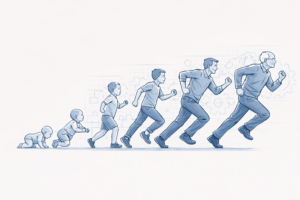
Here’s the reframe most people miss: you don’t force yourself to become disciplined and then start acting disciplined. You act once without force, and that action starts shifting your identity.
You’re not trying to become a morning person through force of will. You’re testing: what happens if I experience one morning where waking early doesn’t require force? Maybe you go to bed in your workout clothes, so morning exercise requires no decisions. Maybe you schedule a 6 AM coffee with someone you actually want to see, so getting up is about connection, not discipline. The leverage point isn’t the consistency—it’s making the first instance friction-free enough that you can observe yourself doing it without force.
The Stanford psychologist Albert Bandura called this mastery experience—evidence that contradicts your existing self-concept. One morning where you wake early without dragging yourself creates more behavioral change than a month of forced wake-ups. Because it’s not about proving you can force yourself. It’s about discovering you don’t need to.
What Discipline Actually Is
Stop trying to force yourself into discipline. Start looking for the leverage point—the single environmental change, the one reframed decision, the tiny design choice that eliminates the internal conflict entirely.
This week, pick one area where you’ve been forcing yourself. Don’t try harder. Instead, ask: where’s the friction point? What’s the decision that requires willpower? Can you remove that decision through environment, timing, or social structure?
The goal isn’t to become the kind of person who can force yourself to do hard things. It’s to become the kind of person who rarely needs to.
Discipline isn’t what you do despite resistance. It’s what remains when resistance is gone.