You know exactly what you should do. You’ve decided—really decided this time—that you’ll write for an hour each morning before checking email. Or that you’ll save 15% of each paycheck. Or that you won’t look at your phone during focused work sessions.
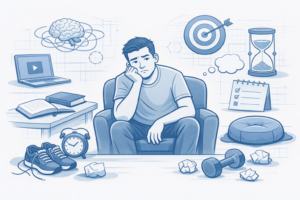
Then tomorrow arrives. The decision you made yesterday suddenly feels negotiable. “Just five minutes of email won’t hurt.” “I’ll save extra next month.” “One quick check.” Before you know it, you’re back in the same pattern you swore you’d break. The problem isn’t that you lack willpower. It’s that you’re forcing yourself to re-make the same decision over and over, dozens of times a day.
Each time you face that choice again, you burn mental energy. And eventually, you lose.
The Tyranny of Endless Choosing
Here’s what’s actually happening: your brain treats every decision—even tiny ones—as a discrete event requiring cognitive resources. Researchers like Roy Baumeister have documented this as “ego depletion,” though recent work suggests the mechanism is more complex than originally thought. The effect appears consistently in certain contexts—judicial rulings, medical decisions, consumer choices—though motivation and meaning can override fatigue in others.
This is decision fatigue in action. It’s why you can resist the donut at 9 AM but cave to the cookies at 3 PM. It’s often cited as the reason leaders like Steve Jobs wore similar outfits daily—a deliberate strategy to reduce trivial decisions and preserve mental bandwidth for choices that actually mattered.
But there’s a deeper problem than just fatigue. Behavioral economist Richard Thaler identified what he calls “present bias”—our tendency to weight immediate costs and benefits far more heavily than future ones. When you decided yesterday to write each morning, your future self seemed rational and disciplined. But when morning actually arrives, present-you faces immediate discomfort (effort, uncertainty) versus delayed rewards (a finished draft weeks from now).
Your future self always loses this negotiation unless you remove the negotiation entirely.
How Ulysses Beat the Sirens (And You Can Too)
The ancient Greeks understood commitment devices better than most modern productivity gurus. In Homer’s Odyssey, Ulysses wants to hear the Sirens’ song but knows their music drives sailors mad, causing them to crash their ships on the rocks. His solution? He orders his crew to tie him to the mast and plug their own ears with wax. Then—and this is the crucial part—he commands them to ignore his future pleas to be freed.
Ulysses didn’t rely on willpower. He physically removed his ability to make a choice he knew his future self would regret.
This is what philosophers like Jon Elster call “precommitment”—the strategic surrender of future options. And it’s backed by decades of behavioral science showing that our future selves are essentially different people with different preferences. You’re not making a decision for yourself. You’re making it for a stranger who will prioritize differently than you do right now.
The paradox is real: by restricting your future options, you gain freedom from the constant cognitive burden of re-deciding. You’re not exercising less willpower—you’re rendering willpower irrelevant.
The Mechanism: Why Commitment Devices Actually Work
Commitment devices operate on three psychological principles:
First, they eliminate the decision point. When you set up automatic transfers to savings, you’re not choosing to save each month. The decision happened once, in the past. Your present self can’t interfere because there’s no choice to make. As behavioral economist Dan Ariely notes, we’re predictably irrational—but we’re also predictably good at predicting our own irrationality. We know we’ll make the wrong choice, so we prevent that choice from existing.
Second, they add friction to undesired behaviors. Every obstacle between you and a bad habit creates a moment where conscious thought can interrupt automatic behavior. James Clear calls this “environment design”—making good habits easy and bad habits hard. When you delete social media apps from your phone, you haven’t eliminated the possibility of using them. You’ve just added enough steps (open browser, type URL, log in) that your automatic reach for distraction hits a speed bump.
Third, they leverage loss aversion. We hate losing what we have far more than we enjoy gaining something new. This is why public commitments work—the thought of admitting failure carries more weight than the pleasure of achieving the goal. Websites like Beeminder exploit this by charging you money if you fail to meet your commitment. The financial loss is often trivial, but the psychological sting is real.
Five Commitment Devices You Can Implement This Week
1. Automate the decision entirely
Set up automatic transfers for savings, automatic bill payments, automatic calendar blocks for deep work. This isn’t just about convenience—it’s about removing the decision from your future self’s jurisdiction. Start small: automate one recurring financial decision this week. The mechanism works because the transaction happens whether or not future-you feels motivated.
2. Create social stakes
Tell specific people about specific commitments with specific timelines. Not “I’m going to exercise more” but “I’m running a 5K on March 15th.” Behavioral science shows that vague goals produce vague results. The commitment device isn’t the goal—it’s the social cost of backing out. Research consistently shows that social accountability significantly increases follow-through, with some studies finding accountability partners more than double your chances of success.
3. Use cash for discretionary spending
Withdraw your weekly discretionary budget in cash. When it’s gone, it’s gone. Behavioral economists call this “mental accounting”—we treat money differently depending on how we categorize it. Physical cash makes spending psychologically “real” in a way that card swipes don’t. You’re not relying on self-control; you’re leveraging the physical reality of an empty wallet.
4. Install friction on distracting behaviors
Delete apps from your phone. Log out of websites after each use. Put your phone in another room during focused work. These aren’t about making bad behaviors impossible—they’re about introducing a pause between impulse and action. In that pause, you remember why you wanted to avoid the behavior in the first place. As psychologist Wendy Wood explains in “Good Habits, Bad Habits,” context cues trigger automatic behavior. Change the context, disrupt the automation.
5. Make the commitment device public and irreversible
Buy the non-refundable gym membership. Register for the conference six months out. Pre-pay for the course. These work because you’ve converted future intentions into present costs. The decision is made; the money is spent. Your future self can procrastinate on attending, but they can’t undo the financial commitment. Loss aversion does the rest. Just be strategic—prepaid commitments work best when you’re genuinely motivated but prone to procrastination, not when you’re ambivalent about the goal itself.
The Real Goal: Working With Your Brain, Not Against It
Here’s what most productivity advice gets wrong: it assumes you should become a person who makes perfect decisions consistently. But decision-making is exhausting, unreliable, and dependent on context you can’t control. You’ll always be more tired at 5 PM than 9 AM. You’ll always experience present bias. You’ll always have finite willpower.
Commitment devices aren’t about fixing these limitations. They’re about designing around them.
Think of it like this: a thermostat doesn’t make your furnace “better” at heating. It removes the need for constant manual adjustment. You set the temperature once, and the system maintains it automatically. Commitment devices do the same thing for behavior—they convert one-time decisions into ongoing systems that run without requiring constant attention.
The writer David Allen talks about “open loops”—unfinished commitments that consume mental bandwidth even when you’re not actively thinking about them. Every time you resist the donut, check your phone, or debate whether to save money, you’re running that decision loop again. Commitment devices close those loops. They free up the mental space you were using to constantly re-litigate the same choices.
This is the paradox at its core: by accepting that you won’t make perfect decisions repeatedly, you make one good decision that sticks. By limiting future freedom, you gain present freedom from decision fatigue, present bias, and the exhausting performance of constant self-control.
Your Next Step: Choose One Decision to Remove
This week, identify one decision you’re tired of making repeatedly. Not your biggest challenge or most ambitious goal—just one recurring choice that drains energy without adding value.
Then eliminate that choice. Set up the automatic transfer. Delete the app. Tell someone the specific deadline. Make the single decision that removes all future decisions.
You’ll know it’s working when you stop thinking about it entirely.