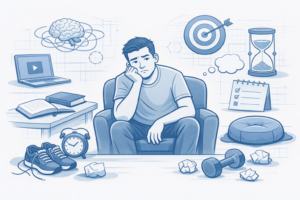
You’ve tried it before. Wake at 5:30 AM. Meditate for twenty minutes. Journal three pages. Cold shower. Green smoothie. Review your goals. Maybe some yoga. By the time you’re supposed to start work, you’re already exhausted from performing productivity.
Then you miss one morning—you sleep through your alarm, or you’re traveling, or you’re just fucking tired—and the whole system collapses. You don’t just skip the routine; you feel like a failure. The discipline you’d built evaporates. You’re back to scrolling your phone in bed, except now you’re also beating yourself up about it.
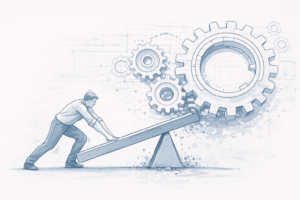
Here’s what nobody tells you: the problem isn’t your lack of discipline. The problem is that you’ve been optimizing for the wrong variable.
The Illusion of the Perfect Start
We’re obsessed with morning routines because they feel like control. Start the day right, the logic goes, and everything else falls into place. There’s some truth there—chronobiologists have confirmed that our prefrontal cortex, responsible for complex decision-making, is typically most active in the first few hours after waking. But we’ve turned this insight into a tyranny of optimization.
Behavioral economist Dan Ariely found that most people do their best analytical thinking within two hours of becoming fully awake. But notice what he’s measuring: analytical thinking, not moral virtue. You don’t need to earn your productivity with a gauntlet of self-improvement tasks.
The real issue is what psychologists call the “planning fallacy”—our tendency to underestimate how long things take and overestimate our future motivation. When you design a morning routine, you’re designing it for the idealized future version of yourself who never snoozes the alarm and always wants to meditate. You’re not designing for the actual human who sometimes stayed up late finishing a project, or who’s fighting off a cold, or who just doesn’t want to do breathwork today.
What Actually Matters: The First Decision
Here’s what the research actually shows: the first decision you make matters more than the first hour you construct.
Stanford behavior scientist BJ Fogg, who’s studied habit formation for decades, has a useful framework: behaviors happen when motivation, ability, and a prompt all converge. Most morning routines fail because they require sustained high motivation (exhausting) and high ability (unrealistic) across multiple behaviors in sequence. One weak link—you’re tired, you’re rushed, you didn’t prep the night before—and the chain breaks.
But a single, well-designed first decision? That’s different. It requires one moment of agency, not an hour of it.
Writer Mason Currey, who studied the daily routines of hundreds of creative professionals for his book Daily Rituals, found something surprising: the most consistent creators didn’t share a morning routine. Some woke at dawn, others at noon. What they shared was a reliable trigger that transitioned them into work mode. For some it was coffee at a specific café. For others it was putting on certain clothes. The ritual itself mattered less than its function as a decision-making shortcut.
Why Your Brain Wants Routines (And Why It Can’t Sustain Them)
Your brain has about 35,000 decisions to make every day. Most are trivial—what to wear, when to eat, which route to take—but each one depletes the same finite cognitive resource. This is decision fatigue, documented extensively by social psychologist Roy Baumeister.
Routines theoretically solve this by automating decisions. The problem is that routines require consistency to become automatic, and life is structurally inconsistent. You travel. Your kid gets sick. Your schedule changes. The gym you go to closes for renovations.
As Nassim Nicholas Taleb points out in Antifragile, systems that require perfect conditions are fragile. They break under stress. What you need isn’t a more elaborate routine; you need a more resilient system. One that accommodates disruption instead of shattering because of it.
What to Do Instead
The goal isn’t to abandon structure. It’s to build structure that works with your reality instead of against it. Here’s how:
1. Identify Your Actual Constraint
Most morning routines are designed as if time is your only constraint. It’s not. Maybe your constraint is energy—you wake up groggy and need 45 minutes to feel human. Maybe it’s decision-making capacity—you’re fine physically but can’t handle choices before coffee. Maybe it’s environmental—you share a small apartment and can’t do yoga without waking your partner.
Design for the constraint you actually have. If you need time to become functional, stop scheduling demanding tasks immediately after waking. If mornings are chaotic because of kids, stop pretending you’ll meditate then. Move it to lunch or right after bedtime. James Clear calls this “environment design”—making the desired behavior easier than the undesired one by working with reality instead of against it.
2. Build the Minimum Viable Morning
Instead of a ten-step routine, identify the one or two things that genuinely affect your entire day. Not things you should do—things that actually work.
For some people, it’s genuinely just coffee and a shower. For others, it’s twenty minutes of movement or ten minutes of writing. The key is specificity and honesty. What actually changes your cognitive state in a way that matters? Strip everything else.
Cal Newport, who studies deep work and productivity, has written about the “deep life stack”—the idea that you need to get the foundational layer right before adding complexity. Your morning doesn’t need to address every area of your life. It needs to reliably get you to a functional starting point.
3. Design for Disruption
Include an explicit Plan B. What’s the twenty-percent version of your routine that you can do on chaotic mornings? This isn’t admitting defeat; it’s acknowledging reality.
Research on implementation intentions—”if-then” plans—shows they dramatically improve follow-through. “If I have a normal morning, I’ll do X. If I’m rushed or didn’t sleep well, I’ll do Y.” This prevents the all-or-nothing thinking that kills consistency.
4. Delay the First Decision
This sounds counterintuitive, but here’s what it means: don’t make your first act of the day a decision at all. Automate it completely.
Every choice you remove from your morning preserves cognitive resources for later. Set out your clothes the night before. Prepare breakfast ingredients. Put your running shoes by the door. Barack Obama wore only blue or gray suits because, as he said, “I don’t want to make decisions about what I’m eating or wearing. Because I have too many other decisions to make.” He was managing decision fatigue by reducing trivial choices.
The first decision of your day should be when you sit down to work, not whether you can muster the willpower to do your morning routine.
5. Track Outcomes, Not Compliance
Stop measuring whether you completed your routine. Start measuring whether you actually got your important work done. This is the shift from process goals to outcome goals.
You might find that on days you skip the routine entirely, you’re just as productive—or more so, because you didn’t exhaust yourself performing productivity before starting actual work. Or you might find specific elements genuinely matter. But you’ll only know if you’re measuring what actually counts.
The Real Function of a Morning
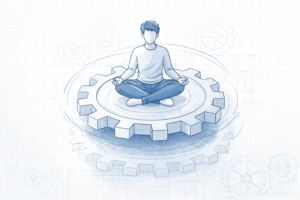
Here’s the reframe: your morning doesn’t need to be an achievement. It needs to be a reliable transition from sleep to agency.
Some people achieve this with elaborate rituals. Others achieve it with coffee and silence. Both are fine. What matters is that you’ve designed a system that gets you to your starting line consistently, even on imperfect days—especially on imperfect days.
Writer Anne Lamott has a useful perspective on this: “Almost everything will work again if you unplug it for a few minutes, including you.” Your morning is that unplugging. It doesn’t need to be aspirational. It needs to be sustainable.
The mornings you’re most proud of—the ones where you did everything perfectly—might not be the ones where you did your best work. Productivity isn’t about virtue signaling to yourself through elaborate routines. It’s about creating conditions where the work you care about actually happens.
What to Try This Week
For the next five days, do this experiment: identify the single behavior that most reliably affects your mental state in the morning. Not what you think should matter—what actually does. Maybe it’s breakfast, or a walk, or just sitting with coffee in silence for ten minutes.
Do only that. Strip everything else. See if your days are actually worse, or if you’ve just been carrying dead weight.
The goal isn’t to find the perfect routine. It’s to find the minimum viable system that gets you to work without depleting you first.