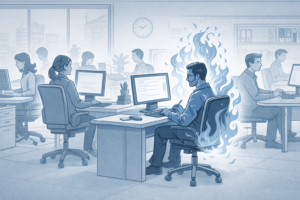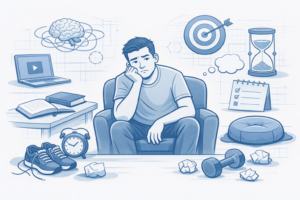
You blinked and it’s already Wednesday. The year you swore would be different is somehow halfway over. Your nephew who was just born is starting middle school.
This isn’t just you being dramatic. When you look back, time genuinely feels like it’s accelerating, and the sensation intensifies with each passing year. What took forever when you were twelve—summer vacation, the week before your birthday, a single math class—now evaporates before you notice it’s begun.
The unsettling part? This isn’t a perception problem you can think your way out of. It’s a consistent pattern documented across experimental psychology studies, rooted in how your brain encodes experience. And without understanding what’s actually happening, the compression only intensifies.
The Mathematics of Subjective Time
The most commonly cited explanation is simple proportionality. When you’re five years old, one year represents 20% of your entire lived experience. When you’re fifty, that same year is just 2%. Psychologist William James noted this over a century ago, observing that time feels proportional to the total time we’ve already lived.
This hypothesis appears frequently in popular psychology, but modern researchers have found it insufficient. The math alone doesn’t explain why individual days feel compressed, or why a routine Tuesday vanishes while a vacation week feels substantial. It’s a historical framework, not the primary mechanism.
Your Brain’s Efficiency Problem
The real culprit is memory encoding. Your brain creates timestamps through novel experiences and attention-demanding events. These timestamps become the landmarks you use to measure time retrospectively—when you look back on a period that’s already passed.
Here’s the trap: Your brain is optimized for efficiency, not for making you feel like you’ve lived a full life. When you repeat the same patterns—same commute, same lunch routine, same evening scroll—your brain stops creating detailed memories. It’s literally compressing repetitive information to save processing power.
Neuroscientist David Eagleman explains this through what researchers call “the oddball effect.” Novel or emotionally significant events are perceived as lasting longer in the moment, and they also create richer, more detailed memories. When you look back, weeks of routine collapse into a blur, while a single unusual afternoon remains vivid. Retrospectively, that unusual afternoon feels longer because it occupies more space in your memory.
Routine is the enemy of perceived duration.
The Attention Economy of Time
There’s a second mechanism at work: attention density. The psychologist and writer Claudia Hammond, in her book Time Warped, describes how attention stretches time. When you’re fully engaged—learning a new skill, navigating an unfamiliar city, having an intense conversation—your brain is processing more information per unit of time.
That processing creates temporal texture. The more your brain has to actively work, the more “stuff” gets encoded, and the longer the period feels in retrospect.
Conversely, autopilot shrinks time. Your daily commute feels instant because you’re not paying attention to it. You’ve driven that route hundreds of times. Your brain has optimized it into a single compressed file: “commute.zip.”
This is why your pandemic year might feel like it simultaneously lasted forever and vanished instantly. Multiple studies documented this temporal disorientation during COVID-19. The lack of novelty and disrupted routines compressed the days in memory, but the emotional weight and stress stretched them.
Why “Living in the Moment” Misses the Point
The standard advice is to “be more present” or “practice mindfulness.” This isn’t wrong, but it’s incomplete and often unhelpful.
The issue isn’t that you’re not present enough. It’s that your life has settled into patterns efficient enough that presence isn’t required. You can cook dinner, respond to emails, and have a conversation on autopilot because you’ve done these things thousands of times.
Mindfulness can increase moment-to-moment awareness, but it doesn’t automatically create the memory-rich experiences that expand time in retrospect. Being present during your identical morning routine doesn’t make it more memorable. You need novelty and salience, not just attention.
Think of it as a cognitive bandwidth problem—when you’re operating in familiar territory, you’re not allocating resources. Your brain is running on low power mode. The behavioral economist Sendhil Mullainathan’s work on mental bandwidth helps illustrate this: routine depletes the need for active processing.
The goal isn’t to somehow be intensely present during every mundane task. That’s exhausting and unrealistic. The goal is to strategically introduce friction that demands attention and creates memorable experiences.
Five Mechanisms to Stretch Subjective Time
1. Inject Strategic Novelty Into Recurring Activities
You don’t need to travel to Thailand to create new memories. You need to break autopilot in your existing routines. Take a different route to work once a week. Try a new grocery store. Rearrange your furniture. Order something unfamiliar at your regular restaurant.
Why this works: Each small variation forces your brain to pay attention and encode a new memory instead of running the “default.exe” file. The goal is not constant chaos—it’s regular interruption of established patterns.
2. Increase Learning Density
Commit to acquiring a new skill every quarter. Not casually—actually allocating time to progress from novice to competent. Learn to make pasta from scratch, study a language twenty minutes daily, take a drawing course, learn basic carpentry.
Why this works: The steepest part of any learning curve happens at the beginning. This is when your brain is forced to create new neural pathways and can’t rely on existing patterns. Beginner struggles create temporal richness through enhanced attention and memory formation. The novelist Haruki Murakami observed that discipline in creative work creates a kind of temporal weight—each day of showing up and doing the work feels more substantial than days of passive consumption.
3. Create Micro-Transitions Between Activities
Before switching tasks, pause for thirty seconds. Close your eyes. Take three breaths. Literally stand up and sit back down. This sounds absurd, but it works.
Why this works: Transitions create episodic boundaries—a well-documented concept in memory research. When you blend activities together—finishing an email while starting a call while thinking about dinner—your brain doesn’t encode separate events. It records a blur. Deliberate transitions tell your brain: “This is a new thing. Pay attention.” It’s the mental equivalent of chapter breaks in a book.
4. Reduce Optimization, Increase Friction
Deliberately make some things less efficient. Take handwritten notes instead of typing. Walk to get coffee instead of making it at home. Call instead of texting. Cook instead of ordering.
Why this works: Efficiency compresses time by reducing the cognitive load of activities. Adding back deliberate inefficiency forces engagement. The philosopher Albert Borgmann called this “focal practices”—activities that demand your attention and skill. They’re not productivity hacks. They’re temporal expansion strategies.
5. Keep a Weekly Novelty Log
Every Sunday, write down three specific things that happened that week that were different from your usual routine. If you struggle to find three things, you know your compression problem is acute.
Why this works: This isn’t journaling for reflection—it’s a diagnostic tool. If you can’t remember three novel events from the past seven days, your brain has compressed the week into a single file. The act of searching for novelty also primes you to notice and create it more deliberately going forward.
The Real Trade-Off
Here’s what nobody wants to hear: Efficient routines compress time, but they also compress stress. The optimized life feels short, but it’s also manageable. Constant novelty stretches subjective time, but it’s cognitively expensive and exhausting.
You don’t want to live in permanent beginner mode. That’s not sustainable. But you also don’t want every day to feel identical until you blink and a decade has vanished.
The goal is strategic novelty within stable routines. You keep the infrastructure that makes life manageable—regular sleep, consistent work rhythms, reliable relationships. But you deliberately inject variation at a pace your brain can handle.
Think of it as scheduled disruption. Not chaos. Controlled exposure to newness.
Start Here
This week, identify one routine activity you do daily and change one variable. Different coffee shop. Different walking route. Different time of day for exercise. Different meal for dinner.
Don’t change everything. Don’t try to suddenly “live more fully.” Just change one thing, and notice whether that day feels more substantial when you reflect on it in the evening.
The point isn’t to transform your life. It’s to test whether the mechanism works for you. Because time isn’t actually speeding up. Your brain is just getting better at compression. And compression, unlike aging itself, is partially modifiable—by increasing novelty, attention, and memory density, you can meaningfully slow how fast life feels when you look back on it.