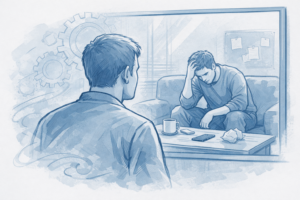
You sit down with your most important task. The one that actually matters. You open the document, position your coffee just right, silence your phone. You’re ready.
Fifteen minutes later, you’ve checked email twice, reorganized your desktop, and somehow ended up reading about whether penguins have knees. The work is still there, untouched, radiating a strange psychic weight that makes scrolling Twitter feel like a rational alternative.
This isn’t a failure of discipline. It’s your brain doing exactly what it evolved to do: avoid cognitive expense and seek immediate rewards. Understanding why this happens—the actual mechanism, not just the symptoms—changes what solutions might work.
The Brain’s Energy Budget
Your brain runs on about 20% of your body’s energy while representing only 2% of its mass. It’s expensive biological hardware, and like any system with limited resources, it has strong preferences about how to spend them.
Deep work—the kind of sustained, focused effort that produces meaningful results—is metabolically costly. When you engage in complex thinking, you’re burning glucose and oxygen at rates your brain would rather avoid. Daniel Kahneman calls this “System 2” thinking: slow, effortful, and deliberately engaged. Your brain defaults to “System 1″—fast, automatic, and cheap.
This isn’t laziness. It’s conservation. Your brain evolved in environments where energy scarcity was a real threat, so it developed sophisticated mechanisms to avoid unnecessary cognitive effort. Every time you attempt deep work, you’re fighting millions of years of optimization for efficiency.
The Reward Prediction Error
Here’s where it gets interesting: your brain doesn’t just resist effort—it’s constantly calculating whether effort is worth it. This calculation happens in the dopamine system through something called reward prediction error.
When you check email or social media, you get immediate, variable rewards. Sometimes it’s nothing, sometimes it’s interesting, sometimes it’s urgent. This unpredictability creates the same dopamine response as a slot machine. Behavioral economist George Ainslie describes this as hyperbolic discounting: we massively overvalue immediate rewards compared to delayed ones.
Deep work offers rewards on a completely different timescale. You might spend three hours wrestling with a complex problem and have nothing tangible to show for it that day. The payoff comes weeks or months later. To your dopamine system, this looks like a terrible investment.
Attention Residue Is Real
When you switch tasks—even briefly—part of your attention stays with the previous task. Psychologist Sophie Leroy calls this “attention residue.” You check Slack for two minutes, return to your writing, and discover that 20% of your cognitive capacity is still processing that message about the meeting schedule.
This effect compounds. Every interruption, every task switch, leaves residue. By mid-afternoon, your attention is fragmented across a dozen incomplete contexts, each claiming mental resources. You’re not doing deep work poorly—you’re attempting it with a fraction of your available cognitive capacity.
The brain doesn’t switch contexts cleanly. It’s more like trying to repaint a wall while the previous coat is still wet. Everything bleeds together.
Novelty Bias and Easy Wins
Your brain is wired to notice and respond to novelty. New information might be important. That notification might be urgent. This made sense when predators and opportunities appeared unpredictably. It makes less sense when you’re trying to analyze quarterly data, but the wiring remains.
Administrative tasks—email, messaging, organizing—provide a steady stream of easy completions. You can clear an inbox, mark tasks complete, organize files. Each completion triggers a small reward. Author Annie Dillard observed: “How we spend our days is, of course, how we spend our lives.” We often spend them on tasks that feel productive precisely because they’re completable, not because they’re important.
Deep work rarely offers this satisfaction. You can spend hours on a problem and end the day with more questions than answers. To a brain seeking completion signals, this feels like failure, even when it’s exactly the kind of thinking that produces breakthroughs.
What Actually Works
Understanding the mechanism suggests different interventions than “try harder” or “be more disciplined.” Here’s what addresses the actual problem:
1. Create artificial deadlines for immediate stakes
Your brain responds to immediate consequences, so create them. Don’t rely on the real deadline three weeks away—tell someone you’ll send them a draft by 5 PM today. The social cost of failing becomes immediate, changing your brain’s reward calculation. This works because you’re adding present-moment consequences to future-payoff work.
2. Design pre-commitment that makes distraction genuinely costly
Use tools like Freedom or Cold Turkey to block distracting sites, but here’s the key: make it painful to undo. Set it so unblocking requires waiting 30 minutes or typing out a long passphrase. You want the friction to break the automatic reach for distraction. Cal Newport writes: “Efforts to deepen your focus will struggle if you don’t simultaneously wean your mind from a dependence on distraction.” Make that weaning structural, not aspirational.
3. Externalize your working memory before starting
Spend five minutes writing down everything you need to remember, every task waiting, every concern you might need to address. Put it in a physical notebook, not a digital system. This isn’t procrastination—you’re clearing RAM. When your brain knows the information is stored externally, it stops using background processes to hold onto it. This directly reduces attention residue.
4. Build session completeness into deep work blocks
Your brain wants completion signals, so give them. Instead of “work on the report,” define a complete session: “Draft the methodology section, even if it’s rough.” At the end, you’ve completed something, even if the larger project continues. This satisfies the completion-seeking mechanism while keeping you engaged in deep work.
5. Track cognitive load across the day
Most people attempt deep work at random times, then wonder why it sometimes works and sometimes doesn’t. Start logging when you attempt focused work and how it goes. You’ll likely discover patterns—maybe you have 90 good minutes after your morning coffee, or maybe deep work after lunch is consistently terrible. Stop fighting your energy curve. Schedule deep work for when your cognitive budget is actually available.
The System Around How You Work
The goal isn’t to override your brain’s preferences. You can’t win that fight consistently. The goal is to build systems that account for how your brain actually operates.
You’re not broken because deep work is hard. It’s supposed to be hard. Your brain is making rational calculations about energy expenditure and reward probability. Those calculations are often wrong for modern knowledge work, but they’re not irrational given the system they’re operating in.
Try This Week
Pick your single most important deep work task. Before you start tomorrow, spend two minutes writing down exactly what “done for this session” looks like. Not done with the whole project—done with this 90-minute block. Make it specific enough that you’ll know when you’ve hit it.
Then work until you hit it, and stop. Let your brain register the completion. You’re training your reward system to associate deep work with achievable wins, one session at a time.