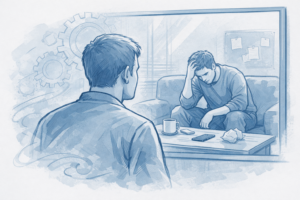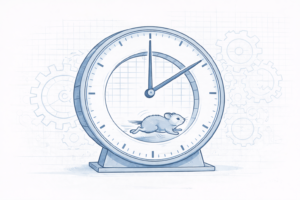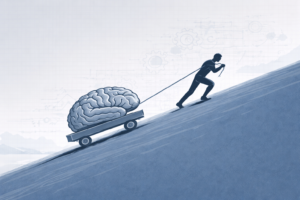
You ended another 12-hour workday. Your inbox is cleared. You attended four meetings. You responded to Slack messages, updated three spreadsheets, and reorganized your task management system. Again.
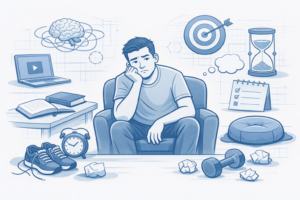
But that project you’ve been meaning to start? Still untouched. The strategy document that could change your team’s direction? Still a blank page. The skill you wanted to build? You watched the course trailer three weeks ago and haven’t returned. You were busy all day—genuinely, exhaustingly busy—but you didn’t get anything important done.
This isn’t a time management problem. It’s a mechanism problem. Your brain is doing exactly what it evolved to do, and the modern work environment exploits that wiring perfectly.
Your Brain’s Urgency Addiction
Here’s what’s happening: Your brain evolved to prioritize immediate, concrete threats and rewards over abstract, distant ones. When a Slack message pings, your brain registers it as urgent—someone wants something now. When your inbox shows 47 unread emails, your brain experiences that as pressure requiring immediate resolution.
The important work—writing that strategy document, learning that new skill, thinking deeply about a complex problem—doesn’t ping. It doesn’t create pressure. It just sits there, patient and quiet, while your brain chases the dopamine hit of clearing notifications.
Behavioral economists call this hyperbolic discounting: we dramatically overvalue immediate rewards compared to future ones. A task that takes 5 minutes and completes right now feels more valuable than a task that takes 2 hours but moves a major goal forward by 20%. The math doesn’t work, but the feeling does.
The economist Sendhil Mullainathan, who studies scarcity and decision-making, describes how urgency creates a kind of cognitive tunneling. When you’re focused on putting out fires, your mental bandwidth narrows. You literally can’t see the bigger picture because your attention is consumed by what’s directly in front of you.
The Completion Bias Trap
There’s a second mechanism at play: completion bias. Your brain rewards you for finishing things, regardless of whether those things matter.
Checking off items produces a small hit of dopamine. Emptying your inbox gives you a sense of accomplishment. Responding to every Slack message makes you feel productive. These are all completable tasks with clear endpoints. You can see when they’re done.
Important work rarely has clear endpoints. “Improve team strategy” doesn’t have a checkbox. “Develop deeper expertise” doesn’t show up as 0 unread. Important work is often ambiguous, complex, and uncomfortable. It requires sustained attention and produces no immediate evidence of progress.
So your brain, optimizing for the feeling of productivity rather than actual progress, guides you toward tasks that feel completable. You spend three hours reorganizing files instead of one hour drafting the difficult email. You update your task management system instead of doing the tasks. You research productivity techniques instead of applying them.
Author and systems thinker James Clear points out that motion and action feel similar but produce different results. Motion is planning, organizing, and researching. Action is doing the thing that produces the outcome. Both can keep you busy. Only one moves you forward.
Why “Visible Work” Feels Safer
There’s a social dimension too. Being responsive—answering emails quickly, attending meetings, being available on Slack—is visible. Other people see you working. It signals conscientiousness, availability, and commitment.
Important work is often invisible. No one sees you thinking. No one knows you’re making progress on something that won’t be ready for weeks. The cultural value placed on being “busy” and “responsive” creates a perverse incentive: visible busyness is rewarded even when it crowds out invisible importance.
Cal Newport, in Deep Work, argues that we’ve created work cultures that optimize for the appearance of productivity rather than the production of value. The person who responds to emails at 11 PM looks more dedicated than the person who spent those hours in focused thought, even if the latter produced work that will matter for years.
This creates a self-reinforcing loop. You feel guilty when you’re not visibly busy. So you fill your time with visible tasks. Which leaves no room for deep work. Which means you never make meaningful progress. Which makes you feel like you need to be even more busy to compensate.
How to Break the Pattern
The solution isn’t to work harder or become more disciplined. It’s to build systems that route around how your brain actually works. Here’s what that looks like in practice:
1. Run the “10x filter” on your task list
Every morning, look at your task list and ask: “If I could only do one thing today, which single task would create 10x more value than everything else combined?” That’s your important work. Everything else is maintenance.
This works because it forces you to distinguish between urgent and important explicitly. Your brain won’t do this automatically—urgency always feels more pressing. You have to override that instinct with a deliberate question.
Do the 10x task first, before email, before Slack, before meetings. Protect it like you’d protect a doctor’s appointment. Because what happens when you check email first? You’ve already lost—you’re now in reactive mode, and important work gets pushed to “later” (which becomes never).
2. Create “obligation-free blocks”
Schedule 2-hour blocks twice a week where you are completely unreachable. No email. No Slack. No meetings. Phone on airplane mode. This isn’t optional focus time—it’s structural protection for important work.
The reason this works: important work requires cognitive continuity. Research on “attention residue” by Sophie Leroy shows that when you switch tasks, part of your attention remains stuck on the previous task. It takes 15-25 minutes to fully transition. If you’re switching every 10 minutes, you never reach full cognitive capacity.
Two uninterrupted hours lets you actually think. You’ll accomplish more in those two hours than in eight hours of fragmented time. Treat these blocks as literally unmovable—like a flight you’ve already booked.
3. Define your “weekly 3” every Monday
Write down exactly three important outcomes you want to achieve this week. Not tasks—outcomes. Not “work on strategy document”—”complete first draft of Q2 strategy.” Not “learn Python”—”build working script for data analysis task.”
This works because important work needs explicit definition. If you don’t name it, it doesn’t exist. The urgency will fill every available minute. By writing three specific outcomes, you create a standard against which to measure your week.
Friday evening, you can ask yourself: “Did I achieve any of my three important outcomes?” If the answer is no—if you were busy all week but none of the important things happened—you have data. You can adjust.
4. Separate “reactive work” from “proactive work” physically
Use different devices, locations, or tools for reactive tasks (email, messages, administrative work) versus important work. Some people use their phone for reactive work and their laptop only for deep work. Others use different physical locations—coffee shop for important work, office for meetings and email.
This creates what behavioral economists call “choice architecture.” By making important work and reactive work feel distinct, you reduce the cognitive load of deciding what to do. When you sit in the deep work location, your brain knows: this is where we do important things.
It also prevents the insidious blending where you “just quickly check email” in the middle of important work, destroying your cognitive continuity and sliding back into reactive mode.
5. Track completion vs. progress weekly
Every Friday, write two lists: “Things I Completed” and “Progress on Important Goals.” The first list will usually be long. The second often short. This gap is your data.
The reason this works: measurement changes behavior. When you explicitly see the divergence between busyness and progress, it becomes harder to confuse the two. You might complete 40 small tasks but make zero progress on your important goals. That contrast, made visible, creates the motivation to protect important work differently.
Over time, you want these lists to converge—not by completing fewer small things, but by ensuring the important things show consistent weekly progress.
The Reframe: Busy Is a Symptom, Not a Virtue
Here’s what matters: feeling busy while accomplishing nothing important isn’t a personal failure. It’s a predictable outcome of how human attention works in modern work environments optimized for responsiveness rather than depth.
Your brain will always prefer urgent over important, concrete over abstract, completable over complex. That’s not a bug—it’s evolutionary wiring. The goal isn’t to override that wiring through pure willpower. The goal is to build external structures that make important work feel as urgent, concrete, and completable as email.
This means accepting that important work requires protection. It won’t happen in the margins. It won’t happen “when things calm down.” Things will never calm down. The urgency is infinite. There will always be more email, more meetings, more fires to put out.
The question is: what are you willing to protect? Because everything you don’t explicitly protect will be consumed by urgency.
One Thing to Try This Week
Monday morning, before you check email, write down one important outcome you want to achieve this week. Not a task—an outcome. Something specific enough that Friday evening you can definitively say whether it happened.
Then schedule one 2-hour block this week to work on only that outcome. Put it in your calendar like a meeting. Treat it as unmovable. During that block: no email, no Slack, no phone.
That’s it. One outcome. One protected block. See what happens.
You might discover that two hours of protected attention produces more meaningful progress than 20 hours of fragmented busyness. And once you see that gap, you can’t unsee it.