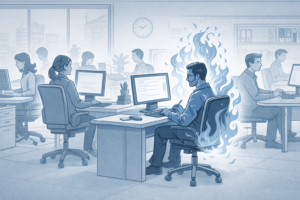
You’ve been making good choices all day. You picked the healthy breakfast. You resisted checking your phone during focused work. You chose the salad over the burger at lunch. You stayed patient during that frustrating meeting instead of saying what you really thought.
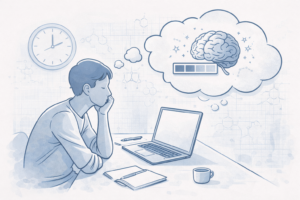
Then you get home, and your partner asks what you want for dinner. Your mind goes blank. You genuinely cannot summon the mental energy to make one more decision. “I don’t care, whatever you want” isn’t apathy—it’s cognitive exhaustion.
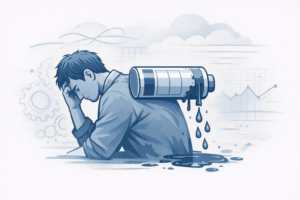
This isn’t a character flaw. It’s decision fatigue, and it’s burning through your mental resources faster than you realize.
The Hidden Cost of Every Choice
Here’s what researchers have consistently observed: decision quality deteriorates after you’ve made many choices. This isn’t about lacking discipline—it’s about how attention, motivation, and mental effort naturally fluctuate throughout the day.
Your brain doesn’t distinguish between trivial and critical decisions in how it allocates effort. What to wear. Which email to answer first. Whether to attend that optional meeting. Coffee or tea. Which task to start with. Reply now or later.
People make thousands of micro-decisions daily, each competing for the same attentional resources. Most are inconsequential, but the cumulative cognitive load is real. Each decision requires you to evaluate options, weigh consequences, and override impulses—processes that feel increasingly costly as the day progresses.
Why Your Decision Quality Deteriorates
Here’s what happens as mental effort accumulates: your brain starts taking shortcuts.
Daniel Kahneman’s work on thinking systems explains the pattern. Your brain operates using two modes: System 1 (fast, automatic, intuitive) and System 2 (slow, deliberate, analytical). Good decisions typically require System 2 thinking—carefully weighing options, considering consequences, resisting immediate impulses.
But effortful thinking feels costly. It requires sustained attention and deliberate control. As you make more decisions, your brain becomes increasingly motivated to conserve effort. This isn’t because you’ve run out of some mental fuel—it’s because your brain has learned that continued effort without recovery is unsustainable. You start defaulting to System 1: easier options, status quo choices, automatic responses.
Studies of parole judges revealed a striking pattern: early in the day, they granted parole at significantly higher rates. As the day progressed, approval rates dropped substantially. Right after breaks—when mental state was refreshed—approval rates jumped back up. While later analyses suggest multiple factors were involved, including case ordering and risk aversion, the pattern highlights how context and fatigue can influence judgment.
The cases didn’t change. The judges’ capacity for effortful deliberation did.
The Motivation Shift
Decision fatigue isn’t about depleting a reservoir of willpower. It’s about shifts in your attention, motivation, and perceived effort.
When you’re fresh, deliberate thinking feels manageable. After dozens or hundreds of decisions, the same level of cognitive effort feels exhausting. Your brain doesn’t lose the ability to make good choices—it becomes increasingly motivated to avoid them.
This leads to three predictable patterns: decision avoidance (procrastinating or refusing to choose), decision simplification (picking the default option regardless of fit), and impulse decisions (choosing immediate gratification over long-term benefit).
Barry Schwartz’s “The Paradox of Choice” documented how excessive options don’t just slow decisions—they actively worsen them. When you’re already experiencing cognitive fatigue, facing 15 types of peanut butter at the grocery store doesn’t represent freedom. It represents one more demand on your limited attention.
The Roman Stoic philosopher Seneca observed that “It is not that we have a short time to live, but that we waste a lot of it.” He was talking about time, but the same applies to mental energy. Most decision fatigue isn’t inevitable—it’s the result of poorly designed personal systems that force you to re-decide the same things repeatedly.
What Actually Works
1. Automate Trivial Recurring Decisions
Identify decisions you make repeatedly that don’t require fresh evaluation each time. Steve Jobs and Barack Obama famously wore the same thing daily—not as a quirk, but as a deliberate strategy to eliminate trivial decisions.
You don’t need a uniform, but you can systematize: same breakfast during the workweek, specific days for specific errands, standing order for regular purchases, default responses to common requests (“I don’t take calls before 10am” instead of evaluating each one).
The key is distinguishing between decisions that benefit from fresh consideration versus those that just drain attentional resources. If your answer would be roughly the same every time, eliminate the decision entirely.
2. Front-Load Important Decisions
Your decision quality is highest early in the day when you’re fresh and motivated. Schedule strategic thinking, difficult conversations, and important choices for morning hours.
This isn’t just about energy levels—it’s about cognitive capacity. The same decision made at 9am versus 4pm will engage different thinking processes. Morning you has greater access to deliberate, analytical thinking. Afternoon you is increasingly reliant on automatic shortcuts and defaults.
Protect your peak decision-making hours. Don’t waste them on email triage or routine tasks. Use them for work that requires genuine judgment.
3. Reduce Your Daily Decision Load
Audit your typical day and identify unnecessary decision points. How many of your choices are actually optional?
Create default options for recurring situations. Meal planning eliminates dozens of food decisions per week. Setting specific work hours eliminates constant “should I be working right now?” evaluations. Having clear criteria for opportunities (“I only take speaking engagements on topics X, Y, Z”) eliminates repeated evaluation of requests.
The goal isn’t rigidity—it’s reducing cognitive overhead so you can be flexible when it actually matters.
4. Build Genuine Recovery Rituals
Mental resources restore during actual rest, not during mindless scrolling. Your brain needs genuine downtime to replenish attentional capacity and motivation.
Breaks that restore cognitive function: brief walks (especially in nature), physical movement, meditation, actual social connection, or activities that engage different neural pathways than your work.
Breaks that don’t: social media scrolling, news reading, or anything that requires continuous micro-decisions (like choosing which video to watch next).
The research is clear: restoration requires stepping away from decision-making entirely, not just switching to different decisions.
5. Create Decision Frameworks
Instead of evaluating every decision from scratch, build reusable frameworks. These are essentially pre-made decisions that you apply to categories of situations.
Example: “I invest in index funds at a fixed allocation ratio” removes the need to decide about individual stocks. “I only check email at 10am, 2pm, and 4pm” removes hundreds of “should I check now?” decisions. “I say no to commitments by default and only say yes when [specific criteria]” creates a clear evaluation path.
Writer James Clear calls these “bright-line rules”—clear boundaries that remove ambiguity. The stricter the framework, the less cognitive load each decision carries.
It’s Not About Having More Willpower
Here’s the reframe: you’re not lazy or undisciplined when you can’t sustain good decision-making all day. You’re experiencing a documented cognitive phenomenon that affects everyone from Supreme Court judges to CEOs.
The solution isn’t building more willpower—it’s building better systems. Deliberate decision-making requires effort and attention that naturally fluctuate. Systems are renewable.
When you understand decision fatigue as a design problem rather than a character problem, the path forward becomes clear. You’re not trying to become someone with infinite mental energy. You’re building an environment that works with the attention and motivation you actually have.
Most productivity advice assumes you should strengthen your willpower through practice. But research suggests that people who appear to have strong willpower actually structure their lives to require less of it. They don’t resist temptation more successfully—they encounter it less frequently.
Start Here
This week, identify one recurring trivial decision you make daily. Something genuinely low-stakes: what to wear, where to work from, what to eat for breakfast, which route to drive.
Remove the decision entirely. Create a default. Build a system.
Notice what happens to your mental energy when you eliminate even one unnecessary choice. That’s not a small thing—that’s reclaiming cognitive resources for decisions that actually matter.