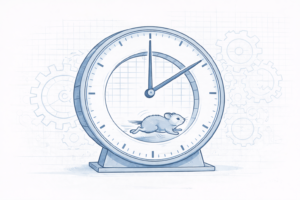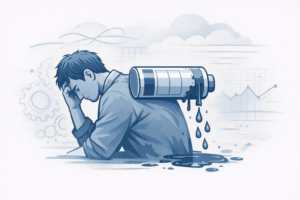
You sit down to write that report. Phone’s on silent. Email’s closed. You’ve got your coffee, your noise-canceling headphones, the perfect Spotify playlist. Everything’s set up for deep focus.
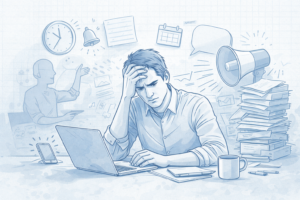
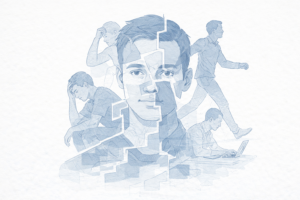
Twenty minutes in, you realize you’ve reread the same paragraph four times. Your mind keeps drifting to that Slack message from earlier, the meeting you have later, whether you should’ve responded differently to your colleague’s comment. You’re not checking your phone, but you’re also not really here.
This isn’t a discipline problem. Something else is happening, and it’s not what most productivity advice addresses.
The Mechanism: Why Your Brain Can’t Shift Gears
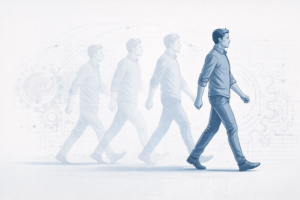
In 2009, business professor Sophie Leroy identified something she called attention residue. Here’s the simplified version: when you switch from Task A to Task B, part of your attention remains stuck on Task A. Your brain doesn’t have a clean “close all tabs” function.
Think about it like this: You’re in a meeting discussing Q4 projections. The meeting ends. You sit down to write code. But your brain is still partially running the meeting simulation—replaying comments, formulating responses you didn’t give, processing the implications of what your manager said. That’s not a character flaw. That’s your brain doing exactly what evolution designed it to do: continue processing important social and survival information until it reaches resolution.
The problem? Modern work creates dozens of these “open loops” every day. Each Slack thread. Each email you read but didn’t answer. Each task you started but paused. Each one leaves residue.
The Hidden Cost of “Just Checking Quickly”
Here’s where it gets worse. You probably think the issue is distraction during work. It’s actually deeper than that.
When you “quickly check” Slack between focused tasks, you’re not just losing those 30 seconds. You’re creating new attention residue. That message about the budget meeting? Now your brain has another incomplete loop to process. That question from your teammate? Another thread your mind keeps pulling.
Herbert Simon, who won a Nobel Prize for his work on decision-making, put it clearly: “A wealth of information creates a poverty of attention.” But it’s not just about information volume. It’s about unresolved cognitive tasks. Each one demands a small slice of your working memory, like browser tabs consuming RAM even when you’re not actively using them.
The mathematician and philosopher Blaise Pascal wrote in his Pensées, “All of humanity’s problems stem from man’s inability to sit quietly in a room alone.” He was talking about spiritual restlessness, but he accidentally diagnosed our modern focus problem: we’ve built an entire economy around making it impossible to sit with one thing.
Why This Feels Harder Now Than It Used To
You’re not imagining it—this is genuinely harder than it was 15 years ago. But not for the reasons you think.
The attention economy isn’t just “distracting.” It’s specifically engineered to create incomplete experiences that generate cognitive loops. Social media notifications don’t just interrupt you—they create unanswered questions (Who liked my post? What did they comment?). Collaboration tools don’t just enable communication—they create ambient awareness of ongoing conversations you’re not part of.
Behavioral economist Richard Thaler’s work on choice architecture shows how environments can be designed to influence behavior without force. The same principles that help people save for retirement can be reversed. Your digital environment is choice architecture optimized for fragmentation.
Every app wants to be “ambient.” Every tool wants to stay open in the background. Every platform wants you to maintain partial attention on it throughout the day. This isn’t a conspiracy—it’s just the logical endpoint of competing for limited attention.
What Actually Works (And Why)
Here’s what helps, tied to the mechanism we just covered:
1. Create “closing rituals” for task switches
Before switching tasks, spend 2-3 minutes externalizing what’s left. Write a single sentence about where you stopped and what comes next. Close the loop explicitly, even if the task isn’t done.
Why it works: You’re giving your brain permission to stop processing this loop. Leroy’s research found that acknowledging what’s incomplete and making a plan reduces attention residue significantly. You’re not finishing everything—you’re telling your brain it’s safe to stop running the simulation.
2. Time-box communication to specific windows
Pick 2-3 times per day to process email, Slack, Teams, whatever. Outside those windows, it’s closed. Not silent—closed.
Why it works: You’re not creating new cognitive loops during focus time. You’re also giving yourself contained periods where it’s fine to have fragmented attention. Cal Newport calls this “context switching scheduling,” but the principle is simpler: batch the fragmenting activities so they can’t pepper your entire day with residue.
3. Design your workspace to have “one job” at a time
One project. One document. One browser window if possible. Physical or digital, doesn’t matter—just singular.
Why it works: Every visible reminder of another task or context creates a micro-pull on your attention. James Clear’s work on environment design emphasizes this: “Every action requires a certain amount of attention. When the environment is messy, your attention is scattered.” You’re reducing the number of ambient cognitive demands.
4. Accept shorter focus blocks than you think you “should” have
Stop fighting for 4-hour deep work sessions. Start with 45-60 minute blocks with actual breaks between them. Use the break to deliberately close loops—finish that quick response, check messages, whatever.
Why it works: Attention residue naturally accumulates over time. Fighting it with sheer willpower is metabolically expensive. Csikszentmihalyi’s research on flow states found that optimal focus happens when challenge matches skill—but your brain’s capacity degrades predictably. You’re working with your cognitive budget, not against it.
5. Make “open loops” visible
Keep a physical or digital space where incomplete tasks, unanswered questions, and pending decisions live. Not a to-do list—a “what’s taking up space in my head right now” list.
Why it works: The Zeigarnik effect shows we remember incomplete tasks better than complete ones. That’s useful for memory, terrible for focus. By externalizing these loops, you’re telling your brain: “I’ve got this documented, you can stop running the background process.”
The Reframe: You’re Not Broken
Here’s the shift: you’re not becoming less disciplined. Your environment is becoming more hostile to sustained attention. That’s not the same thing.
Understanding attention residue doesn’t mean you’ll suddenly have perfect focus. It means you can stop blaming your willpower and start designing around the constraint. You can’t prevent residue from forming—that’s just how brains work. But you can control how much residue you generate and how you handle what accumulates.
The writer Annie Dillard wrote, “How we spend our days is, of course, how we spend our lives.” But she also said this: “A schedule defends from chaos and whim. It is a net for catching days.” You’re not trying to achieve some mythical state of permanent focus. You’re building systems that catch your attention before it scatters completely.
Try This Week
Pick one task that requires real focus. Before you start, close three things that are currently open (browser tabs, apps, documents—whatever). Before you finish, even if the task isn’t complete, write one sentence about where you’re stopping and what comes next.
That’s it. Don’t overhaul your entire system. Just practice creating one clean boundary and one explicit closure. Notice what happens to your attention in the next session.