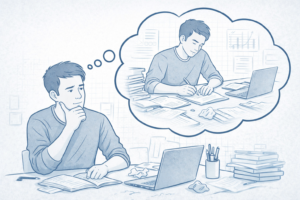
You’ve been staring at your laptop for forty minutes. The task is clear, the deadline is real, but your brain feels like it’s wrapped in cotton. Every productivity guru you’ve ever encountered starts shouting in your head: Just start! Action creates motivation! The hardest part is beginning!
So you force yourself to open the document. You type a sentence, delete it, type it again. Twenty minutes later, you’ve produced three paragraphs that feel like pulling teeth. You’re exhausted, vaguely ashamed, and convinced something is fundamentally wrong with you.
Here’s what nobody tells you: that feeling of resistance isn’t a character flaw. It’s information. And sometimes, the most productive thing you can do is listen to it.
Motivation Isn’t a Character Test—It’s a Signal System
We treat motivation like a moral virtue you either possess or lack. But neuroscience reveals something more interesting: motivation is your brain’s resource allocation system.
When you feel motivated, your brain is signaling that it has the neurochemical resources to tackle a task effectively. Dopamine pathways are primed, your prefrontal cortex has glucose to burn, and your autonomic nervous system is in a state conducive to focus. Psychologist Mihaly Csikszentmihalyi’s research on flow states shows that peak performance happens when challenge meets capability and the neurological conditions are right.
When you don’t feel motivated, your brain is often telling you something important: energy is low, the perceived reward doesn’t match the effort, or another priority is signaling more urgently for attention. Forcing action in this state doesn’t build discipline—it depletes your already-limited cognitive resources.
The Hidden Cost of “Just Starting”
The advice to “just start” relies on a flawed assumption: that the primary barrier to action is psychological inertia, and once you overcome it, momentum takes over. Sometimes this is true. Often, it’s not.
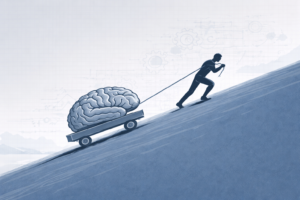
Behavioral economist George Ainslie’s research on willpower shows that self-control operates like a muscle—but not in the way we think. Using willpower doesn’t strengthen it through practice. It depletes it in the short term. When you force yourself to work while unmotivated, you’re spending willpower to overcome resistance, then spending more willpower to maintain focus, then spending even more to produce quality output.
This is why you can “just start” on a task and end up exhausted after 30 minutes with little to show for it. You’ve burned through your cognitive resources fighting your own brain instead of doing the actual work.
Daniel Kahneman describes this as System 2 overriding System 1—your deliberate, effortful thinking system forcing action while your automatic, intuitive system screams that conditions aren’t right. You can win this battle occasionally. Do it chronically, and you’re building a pattern of associating work with discomfort and depletion.
What Your Unmotivated Brain Is Actually Telling You
Lack of motivation usually falls into one of three categories, each with different implications:
Your brain doesn’t see the reward. The task feels pointless, disconnected from outcomes you care about, or so far from any meaningful result that your dopamine system can’t generate anticipation. Neuroscientist Wolfram Schultz’s work on reward prediction shows that dopamine fires not when you receive a reward, but when you anticipate one. If your brain can’t build that anticipation, motivation won’t come.
Your energy is genuinely depleted. Sleep debt, decision fatigue, chronic stress, or simply having already spent your focus budget for the day. As author and mathematician Poincaré discovered during his creative work, the unconscious mind needs specific conditions to process complex problems—conditions that don’t exist when you’re running on fumes.
The task is genuinely misaligned. Sometimes lack of motivation is your brain recognizing that this task, at this time, with these constraints, isn’t the right fit. Self-determination theory, developed by Deci and Ryan, shows that humans need autonomy, competence, and relatedness to feel intrinsically motivated. When a task violates all three—when it’s imposed, too far beyond or below your skill level, and disconnected from people you care about—resistance is rational.
Working With Your Motivation, Not Against It
The goal isn’t to abandon all discipline and wait for inspiration to strike like lightning. It’s to build a more sophisticated relationship with your own motivation cycles.
1. Create motivation conditions instead of forcing motivation itself.
Rather than trying to generate enthusiasm from nothing, engineer the preconditions that make motivation possible. This means: connect the task to a reward you actually care about (not “should” care about), break it down until your brain can see a path to completion, and remove friction between impulse and action.
Author James Clear calls this “environment design”—making the right behaviors easier than the wrong ones. But it goes deeper: you’re designing conditions where your neurochemical systems can function optimally. Get seven hours of sleep. Take a walk before you sit down. Eliminate decision fatigue by planning the night before.
2. Time-box your resistance.
Tell yourself: “I’ll wait 20 minutes and check if motivation shows up.” Use this time strategically—not scrolling, but doing something mildly engaging that doesn’t deplete resources. Take a shower. Do dishes. Walk around the block.
This works because it removes the guilt spiral that kills motivation even further. You’re not procrastinating; you’re conducting an experiment. Often, the break shifts your physiological state enough that motivation surfaces. When it doesn’t, you’ve learned something important about what’s blocking you.
3. Distinguish between “I’m not motivated” and “I’m avoiding discomfort.”
Some tasks will never feel motivating because they’re inherently uncomfortable—difficult conversations, tedious logistics, anything involving uncertainty. Psychologist Steven Hayes’s work on Acceptance and Commitment Therapy shows that experiential avoidance—trying to escape uncomfortable feelings—often creates more suffering than the discomfort itself.
For these tasks, waiting for motivation is waiting for something that won’t come. The question isn’t “do I feel like it?” but “is this aligned with what matters to me?” If yes, you act despite discomfort, not waiting for it to disappear. This isn’t the same as forcing action on a random Tuesday because you “should” be productive.
4. Build motivation through progress, not pressure.
Motivation often follows action, but only when that action produces visible progress. Behavioral scientist BJ Fogg’s research shows that tiny wins trigger dopamine releases that make the next action easier.
The trick is making wins genuinely tiny. Not “write for 30 minutes,” but “write one sentence.” Not “go to the gym,” but “put on gym clothes.” You’re not trying to accomplish the task through micro-actions. You’re letting your brain see that progress is possible, which gradually rebuilds the anticipation that generates motivation.
5. Separate deep work from shallow work based on your motivation rhythms.
Not all tasks require the same motivational state. Cal Newport’s research on deep work shows that cognitively demanding tasks require specific conditions: uninterrupted time, high energy, and genuine engagement.
When motivation is low, this is not the time for your most important creative or analytical work. It is the time for shallow tasks: responding to emails, filing, organizing, updating systems. You’re still productive, but you’re matching the work to your current state instead of demanding your state match arbitrary expectations.
You’re Not Broken—You’re Mismatched
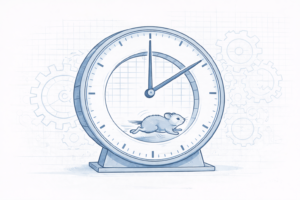
The productivity culture we’ve inherited assumes humans should function like machines: consistent output regardless of conditions. But you’re not a machine. You’re a biological system with ultradian rhythms, hormonal cycles, and neurochemical fluctuations.
Kafka wrote in his diaries about the “impossibility” of writing on command, noting that his best work came during night-time sessions when external pressure dissolved and internal drive emerged. He wasn’t glorifying procrastination—he was recognizing that creative and cognitive work require specific internal conditions that can’t be summoned through willpower alone.
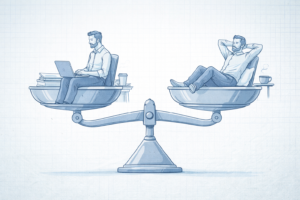
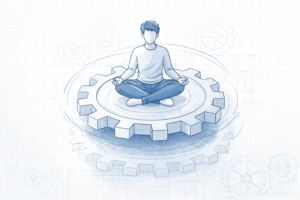
The solution isn’t to abandon structure or deadlines. It’s to build systems that work with your natural motivation cycles rather than constantly fighting them. This might mean clustering certain types of work during your high-energy windows and protecting that time fiercely. It might mean front-loading major projects so deadline pressure arrives when you actually have the resources to respond. It might mean recognizing that chronic lack of motivation about a particular task is data, not deficiency.
Try This This Week
Pick one task you’ve been forcing yourself to do while unmotivated. For the next week, don’t force it. Instead, notice what conditions precede the moments when motivation does show up for other tasks—time of day, energy level, what you did beforehand, environment.
You’re not procrastinating. You’re gathering data about how your motivation actually works instead of how you think it should work. That information is worth far more than another guilt-fueled, low-quality hour of forced productivity.