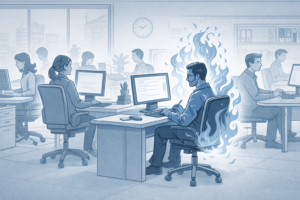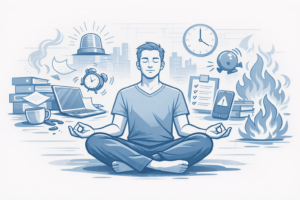
You spent three hours on Sunday setting it up. Color-coded calendar blocks, a pristine task management app, morning and evening routines mapped out to the minute. For the first week, maybe two, it feels incredible. You’re checking off tasks, hitting every time block, feeling like you’ve finally cracked the code.
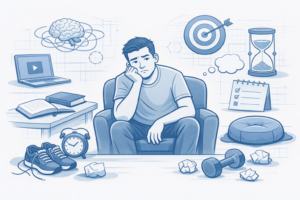
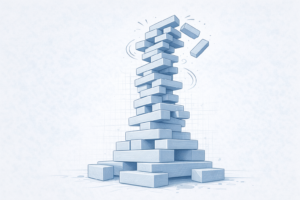
Then Wednesday of week three hits. You miss your morning routine because you slept through your alarm. The rest of the day’s blocks cascade into chaos. By Thursday, you’re back to your old patterns, and the beautifully designed system sits there like an abandoned gym membership – a reminder of good intentions and inevitable failure.
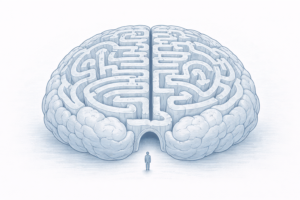
Here’s what almost no one tells you: the problem isn’t your willpower or discipline. The system failed because of how it was designed. Understanding why requires looking at what actually happens in your brain when you adopt new productivity systems.
The Novelty Effect Is Not a Success Signal
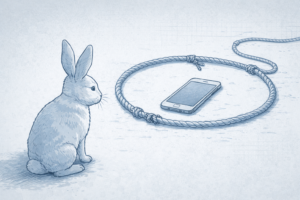
When you start a new system, your brain releases dopamine. Not because the system works, but because it’s novel. Psychologist Nico Bunzeck’s research on the substantia nigra shows that novelty itself triggers reward circuits – the same ones that light up when you get a text message or open a new app.
This creates a dangerous illusion. The system feels effective because you’re engaged, but that engagement comes from newness, not from the system’s actual sustainability. You’re essentially getting high on the act of trying something different.
In a kind of inverse of what behavioral economist Dan Ariely calls “the what-the-hell effect,” you’re artificially succeeding because the failure hasn’t happened yet. Instead of giving up after one setback, you’re riding the wave of initial enthusiasm. The moment routine sets in – usually around the two-week mark when the novelty fully wears off – you’re left with the system’s actual cost-benefit ratio. And if that ratio doesn’t work, the system collapses.
The research is stark: many studies on habit formation show substantial dropout in the early weeks, often before habits have time to stabilize. Not because people are weak, but because they were running on novelty fuel that inevitably burns out.
Your System Has Too Much Friction
Every element in your productivity system requires cognitive load. That color-coded calendar? You need to decide which color. That detailed task breakdown? You need to determine priority levels. Those time blocks? You need to remember to check them.
Each decision point creates what researchers describe as decision fatigue – a small drain on your limited pool of mental energy. Your elaborate system might have twenty decision points before 9 AM. You’re spending cognitive resources to maintain the system before you’ve even started the actual work.
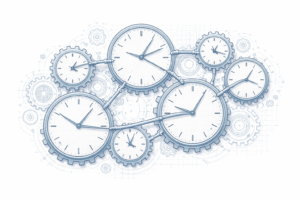
Systems theorist Donella Meadows emphasized that systems with complex feedback loops require ongoing energy to maintain their structure. High-friction systems demand constant input just to keep running. When that energy isn’t available – because you’re stressed, tired, or dealing with an unexpected crisis – the system grinds to a halt.
This is why minimalist productivity advocates like David Allen (Getting Things Done) and Cal Newport emphasize reducing cognitive load. Allen’s “two-minute rule” isn’t about efficiency – it’s about eliminating decision points. Newport’s time-blocking isn’t about rigidity – it’s about making one decision (the block) instead of dozens (individual task priorities throughout the day).
You Built the System for Someone Else
Here’s the core mistake: you designed your productivity system for the person you want to be, not the person you actually are.
Behavioral economist Richard Thaler calls this “present bias” – our tendency to overvalue our future self’s capabilities while undervaluing current constraints. You create a system that assumes future-you will wake up energized, maintain perfect focus, and never encounter unexpected demands. You’re planning for an idealized version who doesn’t exist.
The planning fallacy, documented by Daniel Kahneman and Amos Tversky, shows that we systematically underestimate how long tasks take and overestimate our available energy. You block out eight focused hours because that’s what productive people supposedly do, ignoring that you’ve never actually sustained eight focused hours in your life.
Nassim Taleb writes about “lecturing birds on how to fly” – giving advice that ignores fundamental constraints. Your system lectures you on how you should work while ignoring how you actually work: with variable energy levels, unpredictable interruptions, and biological rhythms that don’t care about your time blocks.
The philosopher William James observed that “habit is the enormous flywheel of society” precisely because habits work with our nature, not against it. Your productivity system is trying to force your nature into a shape it won’t hold.
Practical Solutions That Account for How Systems Actually Break
1. Build in Explicit Failure Points
Instead of designing for perfect execution, design for predictable failure. Block out time for “system maintenance” – 15 minutes at the end of each week to process what broke and why. This isn’t optional admin work; it’s the load-bearing structure that keeps the system flexible.
Add “collapse days” to your routine – one day per week where the system doesn’t apply. Paradoxically, planned breaks make systems more resilient. Taleb calls this “antifragility” – systems that gain from disorder rather than breaking under it.
2. Reduce Decision Points to Near Zero
Audit your system for every moment that requires a choice. Task prioritization? Use a single, automatic rule (most urgent due date, or always do client work first). Time blocking? Use the same blocks every day instead of custom-designing each morning.
The goal is what psychologists call “automaticity” – execution that doesn’t require conscious deliberation. Maya Angelou wrote the same way every day: hotel room, 6:30 AM to 2 PM, same yellow legal pads. Not because she lacked creativity, but because automation freed her cognition for actual writing.
3. Design for Your Minimum Viable Energy State
Your system should work on your worst Tuesday, not your best Monday. What can you actually do when you’re running on six hours of sleep, dealing with a sick kid, and fighting off a cold?
That’s your baseline. Build the system around that state. Everything else is bonus. This inverts the typical approach – instead of aspirational maximums, you’re working with realistic minimums.
4. Make the System Reward Itself
Kahneman’s “peak-end rule” shows that we remember experiences based on their most intense moment and their ending. Your productivity system should create its own positive feedback at natural endpoints.
Don’t just complete tasks – create visible completion signals. A physical object moved from one side of your desk to another. A tally mark on paper. A one-sentence journal entry. The system needs to generate its own dopamine, not rely on the achievement of external goals.
5. Separate Capture from Execution
David Allen’s insight about “ubiquitous capture” isn’t about getting more done – it’s about reducing cognitive load. Your brain can’t relax if it’s trying to remember tasks. Capture everything in a single place (paper, app, voice notes), then have a separate, scheduled time for processing.
This creates what Allen calls a “mind like water” – responsive without being reactive. You’re not maintaining the system constantly; you’re maintaining it at designated moments.
The Real Goal Isn’t Perfection, It’s Persistence
The productivity system that works isn’t the one that optimizes your best days. It’s the one that survives your worst days.
Antifragile systems, in Taleb’s framework, don’t just resist stress – they improve from it. Each time your system encounters disorder and continues functioning, it proves its resilience. The goal is to build something that bends without breaking, that accommodates reality rather than fighting it.
Try This Week: The Minimum Viable System
Pick exactly three recurring tasks you want to maintain this week. Not fifteen. Three. Write them on a physical piece of paper and put it somewhere you’ll see every day.
That’s it. No app, no time blocks, no elaborate tracking. Just three things, visible, with check boxes. At the end of the week, if you maintained it, you’ve learned something about your actual capacity. If you didn’t, you’ve learned that three was still too many.
Build from there.