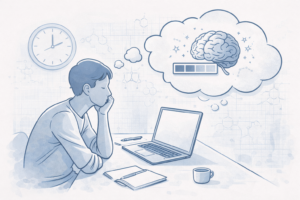
You start the habit with genuine momentum. The gym, or journaling, or that 20-minute reading block you’ve been meaning to build. The first two weeks feel like progress. By week six, it feels like bureaucracy.
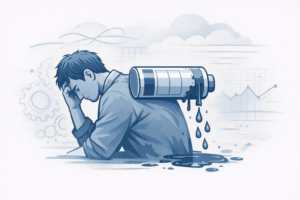
So you quit—or scale back—or let it quietly dissolve into the category of things you used to do. Then, six months later, you restart with the same enthusiasm and the same outcome.
Every article on habit formation gives you the same prescription: make it easy, make it fun, add rewards, find an accountability partner. What none of them say is that your boredom is not a failure signal. It’s a completion signal. And treating it like a failure is exactly why the cycle repeats.
Your Brain Doesn’t Get Bored With Things That Aren’t Working
Wolfram Schultz, a neuroscientist at Cambridge, spent years mapping how dopamine actually functions. The popular version—dopamine rewards pleasure—is wrong. Dopamine fires on prediction error: the gap between what you expected and what you got. When an outcome is better than predicted, dopamine surges. When it matches prediction exactly, nothing fires. When it’s worse, there’s a dip.
Your habit, in the beginning, is full of prediction errors. You don’t know if you’ll finish the run. You don’t know if you’ll feel better afterward. Every session delivers a small surprise. That’s dopaminergic heaven.
By week six, you know exactly what will happen. You’ll do the thing. It’ll feel roughly the same as last time. No surprises left. MIT neuroscientist Ann Graybiel’s research shows that once a behavior gets “chunked” and stored in the basal ganglia, the prefrontal cortex disengages. You’re running on autopilot.
This is not failure. This is graduation.
The Graduation Problem
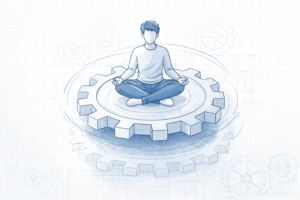
The moment a habit becomes automatic, your brain withdraws conscious attention from it—by design. That’s the entire purpose of habit formation: offload routine to the background so your conscious mind can do something more demanding. When you get bored with a habit, you’re experiencing the system working correctly.
The problem is you’ve been trained to interpret that withdrawal as waning motivation. So you add variety—a new playlist, a new app, a new challenge format. This works briefly. The novelty creates new prediction errors, dopamine fires again, and then you’re bored again in three weeks, now chasing novelty instead of building anything.
You’re not solving the graduation problem. You’re just re-enrolling in the same class.
What the graduated habit actually needs is a new exam, not a new teacher.
Anders Ericsson, whose work on deliberate practice is documented in Peak, found that automaticity and expertise are almost opposites. When a skill becomes unconscious, improvement stops. Expert musicians, surgeons, and athletes don’t let practice become automatic—they constantly introduce specific, measurable constraints that force conscious engagement again. This is not the same as making practice enjoyable. The constraint doesn’t have to be fun. It has to be uncertain.
Raise the Resolution
You’ve been running three miles, four days a week, for two months. You’re bored. The conventional advice: try a new route, new music, run with a friend.
The problem: none of those change what your brain is predicting. It’s predicting a three-mile run and receiving a three-mile run. Matching exactly.
What actually works: add a specific, trackable variable that your brain doesn’t know the outcome of yet. Not “run faster”—too vague. “Beat my Tuesday average pace by 8 seconds on Thursday.” Now there’s a prediction gap. Now there’s something your basal ganglia can’t auto-pilot, because the outcome is genuinely unknown.
One runner, training for her first half-marathon, hit the boredom wall at week five. She wasn’t struggling—she was completing every session easily. She added a single rule: her last mile had to be her fastest. Nothing else changed. But suddenly she had something to solve. She didn’t love those final miles—described them as “low-key dreaded.” But she never missed a session for eleven weeks because her brain was enrolled again, not in the pleasure of running, but in the live question of whether she’d close the gap.
The surprise: adding the constraint made the easy miles feel easier. Knowing the hard part was defined made the rest feel like setup, not slog.
The non-obvious move here is to make the constraint worse, not better. Don’t add a reward for completing the habit. Add a small penalty for failing the constraint within it. Your brain pays more attention to potential loss than potential gain—prospect theory, Daniel Kahneman, well documented. A $5 donation to a cause you dislike for missing your pace target will keep you sharper than any reward system you’ve tried.
Keep Your Identity One Step Ahead
James Clear argues in Atomic Habits that the most durable habits are tied to identity: you don’t try to run, you are a runner. This is right, but incomplete. Because once the identity is established, the behavior that supports it also becomes predicted—and therefore dopaminergically inert.
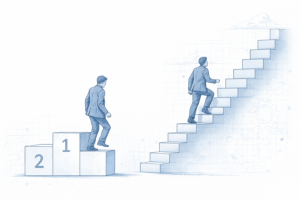
The trick is to keep your identity one step ahead of your behavior. Not “I’m a runner” (settled), but “I’m becoming someone who runs regardless of how I feel” (still unresolved). The incompleteness is the point. Your brain stays engaged when the identity isn’t yet confirmed.
Practically: every six to eight weeks, rewrite your identity claim in a way that’s true but not yet fully proven. “I’m someone who reads every day” becomes “I’m someone who reads things that are genuinely hard for me.” Same habit, different enrollment. Same behavior, new prediction gap. The rewrite takes three minutes and resets your engagement for another two months.
Boredom Is the Diploma
Here’s the reframe: the goal was never to make your habits permanently exciting. The goal was to get bored faster—because the faster you graduate a habit into autopilot, the faster your conscious attention is free for the next challenge.
Stop trying to rescue bored habits with enthusiasm. Diagnose them. Ask: is this habit doing what I wanted it to do? If yes, the boredom is evidence of success, not proof of failure. Then ask: does it need a new prediction gap, or is it genuinely complete?
Some habits should just run on autopilot forever. You don’t need to stay excited about brushing your teeth.
This week: pick one habit you’ve been “failing” at and ask whether you’re actually failing—or whether you already graduated and forgot to enroll in the next level. Add one measurable constraint you don’t know the outcome of yet. See if your brain re-engages within 72 hours.
The best habits don’t stay interesting. They get boring fast enough to become permanent, then invisible enough to make room for the next thing worth caring about.