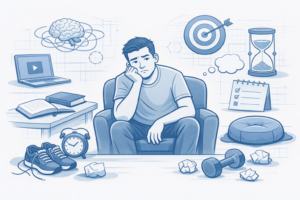
You’ve read Getting Things Done. You time-block your calendar. You’ve tried the Pomodoro Technique, Eat That Frog, and whatever productivity method showed up in your LinkedIn feed last week. You track your deep work hours. You audit where your time goes. And somehow, you’re getting less done than you did in college when your only system was panic and caffeine.
Here’s what nobody tells you: all that trying is the problem.
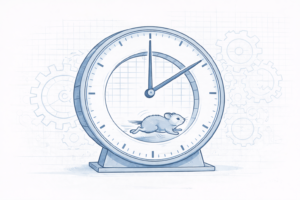
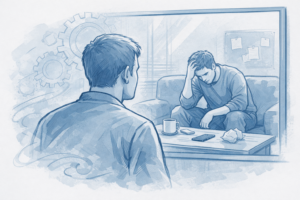
Every productivity system adds a second job on top of your actual job—the job of monitoring whether you’re doing the job correctly. You’re not just writing the report; you’re also tracking whether you’re in a flow state, whether this counts as deep work, whether you should reset your Pomodoro timer. You’re running two processes simultaneously: the work and the surveillance of the work. And the surveillance is winning.
The Cognitive Cost of Watching Yourself Work
Psychologist Daniel Wegner discovered something unsettling about human attention: the harder you try not to think about something, the more mental resources you dedicate to that exact thing. He called it ironic process theory. Tell yourself “don’t think about white bears,” and your brain assigns a monitoring process to scan for white bears, ensuring you think about nothing else.
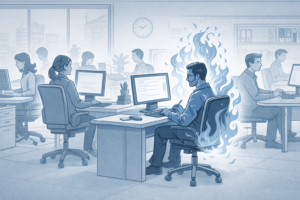
The same mechanism destroys productivity. When you try to be productive, you create a monitoring process that constantly scans: Am I being productive right now? Is this the highest-value task? Should I be doing something else? That scanner runs in the background, burning glucose and attention, the entire time you’re supposedly working.
Mihaly Csikszentmihalyi spent decades studying flow—that state where hours evaporate and you produce your best work. His research revealed a consistent pattern: flow states dissolve the moment self-consciousness enters. The second you step back to observe yourself working, you exit the state that produces real output. You can be in flow or you can monitor whether you’re in flow. Not both.
This is the Surveillance Tax: the cognitive cost you pay every time you check whether you’re being productive. And you’re paying it constantly.
By 10 AM you’ve already decided whether to shower before or after coffee, which shirt to wear, which route to take to work, whether to check email or Slack first, and which of the 47 tasks on your list deserves attention. You’re exhausted before you’ve started anything meaningful. Then you add another layer: monitoring whether those decisions are producing productivity. The system meant to help you accomplish more becomes the thing preventing accomplishment.
Design Friction, Not Surveillance
Sarah, a software developer, tried every productivity method for three years. Nothing stuck until she did something that felt almost stupid: she deleted Slack from her phone and turned off her office WiFi from 9 AM to noon.
Not because she needed to prove her discipline. Because she removed the need for discipline entirely.
The first week felt like withdrawal. Every impulse to check messages hit a wall. But something unexpected happened—she stopped having the impulse to check if she was being productive. The mental surveillance process had nothing to monitor. Without the option to switch contexts, her brain stopped scanning for better options. She wrote more code in those first three WiFi-free mornings than she’d written in the previous month of carefully time-blocked deep work sessions.
The counterintuitive part: her productivity didn’t come from working harder during those three hours. It came from removing the fifty micro-decisions about whether to keep working. Each decision costs attention. Multiply that cost by fifty times per morning, and you’ve spent more energy deciding to focus than actually focusing.
This is friction-based productivity: make the unproductive choice harder to execute than the productive one. Not through willpower—through design. James Clear calls these “commitment devices,” but the real power isn’t in committing to doing something. It’s in removing the recurring choice of whether to do it.
Replace Progress Tracking with Environmental Design
Marcus used to start each day reviewing his task list, categorizing items by urgency and importance, then tracking which quadrant he spent time in. He felt productive. He was producing almost nothing.
Then he tried something different: instead of tracking his time, he tracked his environment. Monday mornings, his desk held only the quarterly planning document and a notebook. Nothing else. Not his laptop. Not his phone. Just the document and space to think.
He’d spend the first hour writing—by hand—three strategic questions the quarter needed to answer. Not tasks. Questions. Then he’d put the notebook away and not look at it again until next Monday. The rest of the week, his desk held only materials for whatever project those questions pointed toward.
The shift wasn’t about better planning. It was about eliminating the task of constantly re-evaluating the plan. His desk environment made the decision for him. No choice, no surveillance, no tax.
The cognitive science here is solid: decision fatigue is real, but the fatigue doesn’t come from making decisions. It comes from the awareness that you’re making decisions. When your environment makes the decision for you—when there’s literally nothing else on your desk—your brain stops offering alternatives. The surveillance process powers down.
The Absorption Architecture
Here’s the reframe: productivity isn’t something you achieve through effort. It’s what remains when you remove the obstacles to absorption.
Think about the last time you lost three hours without noticing. You weren’t monitoring your productivity. You weren’t congratulating yourself for staying focused. You probably forgot you were trying to accomplish anything. You were just in it—the conversation, the problem, the creation. That’s not a special state you need to earn through discipline. It’s the default state that emerges when you stop interrupting it.
Naval Ravikant observed that “desire is a contract you make with yourself to be unhappy until you get what you want.” Productivity systems create the same contract: you’ll be inadequate until you execute the system correctly. The system becomes another thing to want, another gap between where you are and where you should be. Another reason to monitor, evaluate, adjust.
The way out isn’t a better system. It’s designing a life where the system is invisible.
This week, pick one three-hour block. Remove every option except the one thing you need to do. Not through discipline—through design. Delete the apps. Turn off the router. Put your phone in another room. Make the unproductive choice require effort instead of the productive one.
Then stop checking whether it’s working. The surveillance is the problem. The work is the solution. And the work only happens when you forget you’re trying.