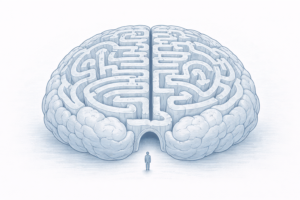
You follow twelve founders on Twitter who are exactly where you want to be. You’ve watched every interview with that author whose career path mirrors your dreams. You know the morning routine, the productivity system, the decision that changed everything. You’re marinating in their ambition, absorbing their strategies, waiting for that clarity to catalyze your own pursuit.
Except it never does. And here’s what nobody tells you: it’s not supposed to.
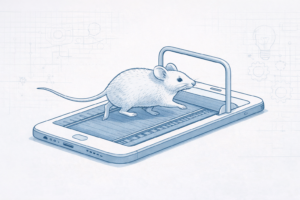
Your brain doesn’t distinguish between closely observing someone pursue a goal and pursuing it yourself. The same neural machinery fires whether you’re taking action or watching someone else take it. This isn’t motivation failing you. This is your motivation system functioning exactly as designed—just aimed at the wrong target.
The Satisfaction You Never Earned
When you read about a founder’s product launch, your mirror neurons simulate the experience. When you watch someone’s creative process unfold in real-time through their content, your anterior cingulate cortex tracks their progress as if it were yours. Neuroscientist Giacomo Rizzolatti’s discovery of mirror neurons revealed something unsettling: observation and execution activate remarkably similar neural patterns.
The problem isn’t the similarity—it’s what your reward system does with it.
Your brain runs on prediction. It’s constantly forecasting: if I do X, I’ll feel Y. Dopamine doesn’t spike when you achieve something; it spikes when you predict you will. And here’s the trap: observing someone else’s achievement teaches your brain to predict similar satisfaction, delivering the neurochemical reward without requiring the actual effort. You get the hit, your brain logs “goal progress,” and your urgency to act dissolves.
This is Simulation Satisfaction—when your brain’s simulation of achievement generates enough reward signal to suppress actual pursuit. You’re not lazy. You’re experiencing a cognitive efficiency hack gone catastrophically wrong.
Cognitive scientist Andy Clark describes human brains as “prediction machines” constantly minimizing surprise. Following someone’s ambition in granular detail gives your prediction engine high-resolution data. It can simulate their path so precisely that the simulation itself feels like progress. You know what they’d do in your situation because you’ve watched them navigate a hundred similar situations. Your brain treats this knowledge as preparation, as movement toward the goal, when it’s actually a replacement for it.
The Voyeurism Spiral
Check what happened yesterday: You spent 20 minutes reading a thread about someone’s writing breakthrough. You felt that familiar surge—yes, this is what I need to understand. You saved it. You felt productive. You might have even opened your own draft document.
But you didn’t write. Because the surge already happened. The reward already landed.
The more detailed your observation, the stronger the effect. This is why watching someone build a company in public, document their fitness transformation, or narrate their creative process feels so much more compelling than generic success stories. The specificity feeds your simulation engine. You’re not just inspired by the outcome—you’re cognitively rehearsing the process, which your brain interprets as executing the process.
Clinical psychologist Ethan Kross’s research on “experience-taking” shows that when we deeply immerse in someone else’s narrative, we temporarily adopt their goals and emotional states. This isn’t empathy—it’s identity merging. And while that’s powerful for understanding others, it’s devastating for pursuing your own ambitions. You can’t hold someone else’s goal and your own in your head simultaneously with equal urgency. The observed goal, because it’s more detailed and further along, wins.
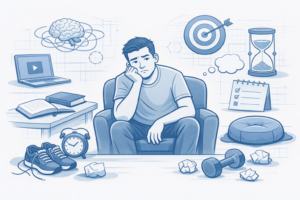
Here’s the test: When you close Twitter or YouTube or that podcast app, does the energy transfer to your own work, or does it evaporate? If it evaporates, you’re not gathering inspiration. You’re outsourcing ambition.
Breaking the Simulation Loop
The solution isn’t to stop learning from people ahead of you. It’s to create incompatible inputs that force your brain to distinguish observation from action.
Sarah, a developer I know, had followed six senior engineers religiously—their blog posts, their conference talks, their GitHub commits. She could articulate their architectural decisions better than her own. Then she tried something: for every post she read about someone else’s code, she had to write one paragraph about her messiest function and one specific thing she’d change. Not plans to change it. The actual character-by-character diff she would commit.
The specificity shattered the simulation. Her brain couldn’t treat “I would refactor the authentication middleware to separate validation from business logic” as the same as actually writing the separation. The gap between simulation and execution became visceral. Within three weeks, she’d shipped more architectural improvements than in the previous six months. The shift wasn’t motivation—it was breaking the false equivalence her prediction system had created.
The mechanism: when you articulate your own specific, unglamorous reality immediately after consuming someone else’s polished narrative, you force your brain to run two incompatible simulations. One is abstract and complete. One is concrete and broken. The prediction engine can’t smooth them into the same path. It can’t deliver vicarious satisfaction because the comparison highlights the gap.
This works for any domain. Follow a writer? Write one ugly sentence about your actual topic before closing the tab. Follow a founder? Document one customer conversation you’re avoiding. Follow a designer? Screenshot the specific interface element in your project that doesn’t work. Make your reality more specific than your observation.
The Consumption Audit
Track this for one week: every time you consume content about someone pursuing a goal adjacent to yours, immediately write down the specific next action you would take if you cared about this goal as much as you claim to. Not “work on the project.” Not “make progress.” The granular next 15 minutes of execution.
Most people can’t do it. They can articulate the person they’re watching with high fidelity—the tools they use, the process they follow, the decision framework they reference. But ask them to articulate their own next action with equal specificity, and it dissolves into abstraction. “Figure out the approach.” “Do some research.” “Think through the strategy.”
This asymmetry is the tell. You’ve encoded their ambition at higher resolution than your own.
The writer Austin Kleon talks about “being a documentarian of your own life” rather than a consumer of others’. But he’s pointing at mechanism, not just mindset. Documentation forces specificity. Specificity breaks simulation. When you document your own messy middle with the same detail you’ve been consuming about others’ polished process, your brain can no longer conflate them. The gap becomes undeniable.
What Ambition Actually Requires
Here’s the reframe: ambition isn’t something you consume. It’s something that consumes you. The difference between inspiration and vicarious satisfaction is whether the energy moves toward your work or away from needing to do it.
Real ambition feels like irritation. Like incompleteness you can’t ignore. Like a specific problem you can’t stop rotating in your mind. It doesn’t feel like admiration for someone who’s solved that problem—it feels like resentment that the solution doesn’t exist yet in your context, in your hands, for your specific constraints.
If following someone makes you feel calm, educated, and patient with your own timeline, you’re not gathering fuel. You’re burning it.
This week: Unfollow half the people who are “where you want to be.” Not because they’re not valuable, but because your brain needs to stop simulating their path and start executing yours. The discomfort of removing that high-resolution input is the discomfort of your prediction system withdrawing from false satisfaction.
Then watch what happens when you stop consuming someone else’s ambition in 4K. The gap stops being theoretical. It becomes a hunger that observation can’t feed. And hunger, unlike inspiration, doesn’t evaporate when you close the app. It follows you to the desk, to the code editor, to the blank page.
Your heroes aren’t giving you a map. They’re giving your brain permission to spectate.