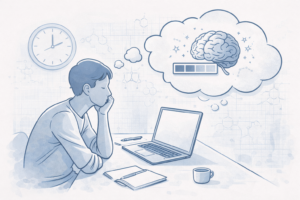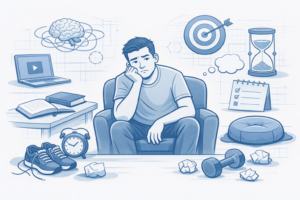
You’ve set up the dedicated workspace. You “close” your laptop at 6 PM. You’ve told everyone you’re “offline after hours.” And yet Sunday evening still feels like Monday morning started early, and Wednesday afternoon contains a vague guilt about the laundry you’re doing between Zoom calls.
The advice keeps telling you the problem is boundaries. Firmer ones. Clearer ones. Physical barriers between your work corner and your living room, temporal barriers between work hours and personal time. You keep trying to build better walls, but here’s what nobody’s saying clearly: you’re trying to separate two things that no longer have edges.
Remote work didn’t ruin your work-life balance. It revealed that “balance” was always a spatial metaphor we mistook for a solution.
The Framework That Stopped Working
Work-life balance made perfect sense when work happened in an office from 9 to 5. You had physical separation doing the heavy lifting—the commute was a built-in transition, the office was a container for work thoughts, and 6 PM meant the workday had structurally ended whether you felt “done” or not.
That framework assumed work was a PLACE you went to, not a STATE you entered.
What remote work actually did was remove the environmental scaffolding that made “balance” feel achievable. You weren’t balancing your time between work and life—the office location was doing it for you. Now you’re trying to recreate that external structure through pure willpower and calendar blocks, and wondering why it feels like swimming against a current.
Psychologist Mihaly Csikszentmihalyi found that the quality of an experience depends less on what you’re doing than on the boundaries around attention. A meeting isn’t draining because meetings are inherently terrible—it’s draining because you’re simultaneously monitoring Slack, aware of your kid in the next room, and noticing the dishes in your peripheral vision. The cognitive tax isn’t from work itself but from the continuous micro-switching between contexts that used to be separated by walls and miles.
Attention Allocation: The Actual Problem
Here’s the reframe: remote work isn’t a work-life balance problem. It’s an attention allocation problem in an environment of continuous availability.
Gloria Mark’s research on attention fragmentation found that it takes an average of 23 minutes to fully regain focus after an interruption. But here’s the part that matters: in remote work, you’re not just interrupted by external pings. Your environment itself may be fragmenting your attention—the coffee maker that signals weekend morning, the couch that means relaxation, the bedroom that means sleep. You’re in a space your brain has learned to associate with rest, trying to maintain focus on work, while also being physically available to non-work demands.
The old framework would say: separate them better. The new framework says: recognize that you’re managing cognitive switching costs, not building walls.
Strategy One: Time-Blocking Based on Cognitive Load, Not Tasks
Most remote workers time-block by task type: emails here, deep work there, meetings in the afternoon. This is still using the old spatial logic—putting different work in different boxes.
Instead, block by attention requirement. High-stakes writing gets morning hours not because mornings are “deep work time” but because that’s when you can afford the 20-minute ramp-up to full immersion. Slack responses get batched into 30-minute windows not because they’re less important but because they require rapid context-switching that’s less costly when you’re already fragmented.
Sarah, a product manager, started blocking her calendar this way and found something surprising: she moved her 1:1s with her team to right before lunch. Not because that’s when she had time, but because these conversations required presence but not deep focus, and placing them before a natural break point (lunch) meant the transition cost was absorbed by something she’d do anyway. The unexpected benefit: her team started bringing more substantive topics to these meetings because she was genuinely present, not trying to protect focus for the “important work” coming after.
The principle: match the attention requirement to when you can absorb the switching cost, not when the task feels like it should happen.
Strategy Two: Create Completion Triggers, Not Time Boundaries
You can’t close the laptop at 6 PM and feel “done” because remote work rarely produces the clear completion signals that office work provided—the commute home, the emptying office, the physical separation from work materials.
The solution isn’t stricter time boundaries. It’s building completion rituals that your brain can recognize as endpoints.
Psychologist Peter Gollwitzer’s research on implementation intentions—precommitting to specific if-then responses—offers a framework, but for remote work, you need completion intentions: concrete signals that today’s work container is closed.
Marcus, a consultant, tried the standard advice—shut down laptop, close office door—but found himself reopening everything an hour later. What worked: a 10-minute end-of-day protocol where he writes three sentences about tomorrow’s first task, moves all open browser tabs into a “tomorrow” bookmark folder, and texts his accountability partner “done.” The last part matters most—externalizing the completion makes it real. The surprise: he thought he’d resent the extra 10 minutes. Instead, he found himself defending that ritual fiercely because it was the only thing that made evenings feel like evenings.
The mechanism: your brain doesn’t recognize “5:30 PM” as meaningful. It recognizes procedural completion.
Strategy Three: Design for Porousness, Not Separation
The balance metaphor assumes you want work and life in separate containers. But here’s what remote workers actually report: they value the FLEXIBILITY to throw in laundry at 2 PM and take a call at 7 PM if it means avoiding traffic to a client site. The problem isn’t porousness—it’s unmanaged porousness.
Instead of fighting the blend, architect it deliberately.
The remote workers who report highest satisfaction aren’t those with the strictest boundaries—they’re those who have clear protocols for HOW the boundaries will flex. Not “I never work after 6” but “I’ll take urgent calls until 8 PM, but I don’t check Slack after 6 unless I’ve told someone I will.”
The difference: one is a rule you’ll break and feel guilty about. The other is a system you’ve designed that accounts for reality.
What nobody tells you: the guilt isn’t from working at weird hours. It’s from violating your own stated boundary and feeling like you failed at discipline. Remove the rigid rule, replace it with a flexible protocol, and the guilt evaporates.
The Reframe Nobody’s Offering You
Stop trying to achieve work-life balance. Start designing an attention budget.
You don’t have unlimited attention. Remote work made this brutally obvious by removing the environmental constraints that used to manage your attention for you. The office decided when you’d be in work-mode. The commute created forced transitions. The physical separation meant you literally couldn’t check work email from your couch at 9 PM.
Now you can. Which means you must actively decide—not once, with a boundary rule, but continuously, with a protocol for allocation.
The weekly action: every Sunday, identify your three highest-attention-cost activities for the week (the presentation prep, the difficult conversation, the strategic planning). Block them for when you have 90+ minutes of protected attention available. Everything else gets scheduled around these, not by importance but by cognitive switching cost.
Here’s what changes: you stop feeling like you’re failing at balance and start recognizing you’re managing a finite resource in an environment designed to fragment it. The question shifts from “How do I separate work and life?” to “Where does this attention need to go right now, and what’s the cost of switching it?”
Work-life balance assumed your problem was time. Attention allocation recognizes your problem is switching costs in continuous availability. One framework sets you up to fail at something that no longer structurally exists. The other gives you a tool that works in the environment you’re actually in.