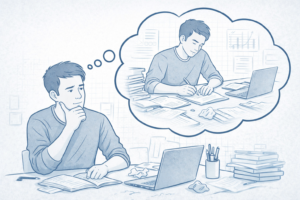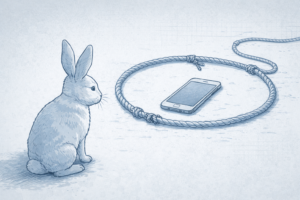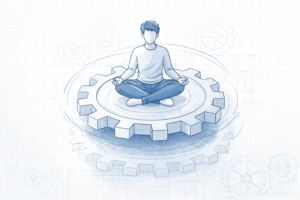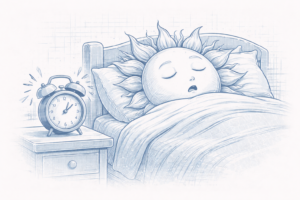
You’ve read the articles. You’ve tried time-blocking, notification-killing, and that Pomodoro thing everyone swears by. You’ve woken up at 5 AM to get “deep work” done before the day explodes. And still, by 10 AM, you’ve been pinged about the client crisis, pulled into a “quick sync,” and asked to review something that “won’t take long.” The productivity advice worked great—for the person you’re not and the job you don’t have.
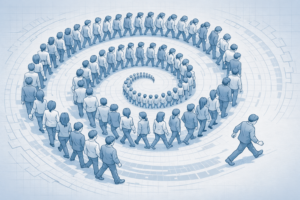
Here’s what those articles miss: you’re not failing at focus. You’re succeeding at the wrong game. You’ve built a productivity system optimized for uninterrupted time in an environment that will never, ever give it to you. The chronically interrupted aren’t undisciplined—they’re playing by rules designed for a different workplace entirely.
The real problem isn’t the interruptions. It’s that you’re trying to do uninterruptible work in an interruptible world.
The Architecture Problem
Gloria Mark’s research at UC Irvine found that knowledge workers are interrupted (or self-interrupt) every 3 minutes and 5 seconds on average. The standard response? Eliminate the interruptions. Build fortresses of focus. But here’s what’s actually happening: you’re not just getting interrupted—you’re interruptible. Your work is structured in chunks that take 90 minutes of sustained attention. A proposal. A strategy doc. A complex analysis. These require what I’ll call “completion architecture”—you start at the beginning and build toward a finished thing.
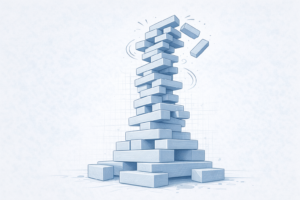
Completion architecture fails the moment someone needs you. Because when you get interrupted at minute 47 of a 90-minute task, you don’t just lose 2 minutes to the interruption. You lose the entire cognitive scaffold you’d built. The context. The flow state. The seventeen tabs you had open in your working memory. Starting again isn’t resuming—it’s rebuilding from rubble.
So you do what every chronically interrupted person does: you wait. You hoard your real work for mythical future blocks of uninterrupted time. Tuesday afternoon when everyone’s in that long meeting. Saturday morning. Someday when things calm down.
They never calm down.
The Momentum Alternative
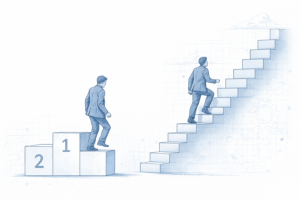
What if you stopped trying to protect completion and started building for momentum instead?
Momentum architecture doesn’t ask “How do I finish this?” It asks “What’s the next true thing I can establish in 8 minutes that moves this forward?” Not a full draft—a claim you can defend. Not a complete analysis—one comparison that reveals something. Not the whole presentation—the frame that everything else will hang on.
David Allen, who created Getting Things Done, understood this accidentally. His “next action” framework works not because it breaks projects into steps, but because it breaks them into atoms—units of work that survive interruption. But he was thinking about task management. I’m talking about intellectual architecture.
Here’s the shift: a traditionally-structured proposal might have an intro, three main sections, and a conclusion. That’s completion architecture—you can’t send sections 1 and 3 without section 2. But momentum architecture for the same proposal? A series of self-contained claims, each with its own evidence. Claim 1 stands alone. If you finish claim 1 and get interrupted for three hours, claim 1 is still valid. You didn’t lose progress—you banked it.
Redesign your actual work units. Sarah, a product manager drowning in interruptions, stopped writing comprehensive strategy docs. Instead, she started writing “decision memos”—single-page arguments for one specific choice, with just enough context that anyone could read it cold. Each memo took 15-20 minutes of actual thinking time, spread across dozens of interruptions. She’d write the core claim in one slot. Add the critical evidence in another. Polish the recommendation while half-listening to a meeting that didn’t need her. In six weeks, she’d produced more strategic thinking than in the previous six months—not because she found more time, but because she stopped needing continuous time. The work units matched her actual available attention. When her director asked how she was suddenly so prolific, she showed him a folder with 47 decision memos, each created in the gaps between everything else.
Make progress lockable. Atul Gawande wrote about “activation energy” in surgery—the mental effort required to start a complex procedure. Every interruption in an interrupt-driven day costs you that activation energy again. The solution isn’t eliminating interruptions; it’s lowering activation energy to nearly zero. This means each work session must end with such clarity that future-you (post-interruption) can restart without rebuilding context. Not just notes about what you were doing—a literal next sentence to complete, a specific question to answer, a precise paragraph to write. When you stop, you’re not abandoning work-in-progress. You’re setting up a ramp so frictionless that you can be productive in the 6 minutes before the next interruption. The difference between “I was working on the budget analysis” and “I need to calculate whether the 18% increase in cloud costs is offset by the reduced headcount in IT—the numbers are in cells B7 and B12” is the difference between 5 minutes of setup time and 30 seconds.
Divorce output from session length. The tyranny of the “deep work” narrative is the assumption that anything meaningful requires 90+ minutes of focus. But Herbert Simon won a Nobel Prize partly for his insight that experts chunk information differently than novices. They see patterns, not steps. What looks like it requires continuous time often just requires compressed expertise. A senior developer can see the architectural flaw in 4 minutes that would take a junior developer 4 hours to find—not because they’re faster, but because they’re seeing different units. You can train yourself to think in denser, more compressed chunks. When Marcus, an attorney, tracked his actual productive output, he found his best legal reasoning happened in 12-minute bursts between meetings, not during his “protected time.” Why? Because the constraint forced precision. He couldn’t meander into his argument—he had to know it immediately. The interruptions weren’t destroying his thinking; his protected time was letting him be sloppy.
What You’re Actually Optimizing For
The deepest reframe isn’t about techniques. It’s about what you’re trying to prove. Every time you say “I just need a few hours of uninterrupted time,” you’re really saying “I can’t do meaningful work unless the world cooperates.” That’s not a productivity problem—it’s an identity problem.
The chronically interrupted who actually produce extraordinary work aren’t the ones who finally get their calendar under control. They’re the ones who stopped treating interruptions as obstacles to productivity and started treating continuous time as a luxury that’s nice when it happens but not required for momentum.
This week, take one project you’ve been waiting for “real time” to tackle. Break it into the smallest intellectually honest unit—not a task, but a claim you can establish, a comparison you can make, a frame you can build. Give yourself 8 minutes. See what’s actually possible when you stop optimizing for the day you’ll never have.
Interruptions aren’t your productivity problem. Your productivity system’s dependence on their absence is.